|
Upland Plant Communities |
Wetland Plant Communities
|
Aquatic |
Disturbed |
|
|
|
|
|
The coastal strand occurs on well
drained sandy soils and includes the typically zoned vegetation of the upper
beach, nearby dunes, or coastal rock formations. This community generally
occurs in a long, narrow band parallel to the open waters of the Atlantic Ocean
or Gulf of Mexico, and along the shores of some saline bays or sounds in both
north and south Florida. This community occupies areas formed along high energy
shorelines, and is strongly affected by wind, waves, and salt spray. Vegetation
within this community typically consists of low growing vines, grasses, and
herbaceous plants with very few small trees or large shrubs. Pioneer or early successional herbaceous vegetation characterizes the foredune and upper beach,
while a gradual change to woody plant species occurs in more protected areas
landward. Typical plant species include beach morning glory, railroad vine, sea
oats, saw palmetto, spanish bayonet, yaupon holly, wax myrtle, along with sea
grape, cocoplum, and other tropicals in southern Florida. The coastal strand
community only includes the zone of early successional vegetation which lies
between the upper beach, and more highly developed communities landward.
Adjacent or contiguous community types such as xeric oak scrubs, pinelands, or
hardwood forests would therefore be classified and mapped respectively.
Dry prairies are large native grass
and shrublands occurring on very flat terrain interspersed with scattered
cypress domes and strands, bayheads, isolated freshwater marshes, and hardwood
hammocks. This community is characterized by many species of grasses, sedges,
herbs, and shrubs, including saw palmetto, fetterbush, staggerbush, tar flower,
gallberry, blueberry, wiregrass, carpet grasses, and varous bluestems. The
largest areas of these treeless plains historically occurred just north of Lake
Okeechobee, and they were subject to annual or frequent fires. Many of these
areas have been converted to improved pasture. In central and south Florida,
palmetto prairies, which consist of former pine flatwoods where the overstory
trees have been thinned or removed, are also included in this category. These
sites contain highly scattered pines which cover less than 10 to 15 percent of
an area.
The pinelands category includes north and
south Florida pine flatwoods, south Florida Pine rocklands, and commercial pine
plantations. Pine flatwoods occur on flat sandy terrain where the overstory is
characterized by longleaf pine, slash pine, or pond pine. Generally, flatwoods
dominated by longleaf pine occur on well-drained sites, while pond pine is
found in poorly drained areas, and slash pine occupies intermediate or
moderately moist areas. The understory and groundcover within these three
communities are somewhat similar and include several common species such as saw
palmetto, gallberry, wax myrtle, and a wide variety of grasses and herbs.
Generally wiregrass and runner oak dominate longleaf pine sites, fetterbush and
bay trees are found in pond pine areas, while saw palmetto, gallberry, and
rusty lyonia occupy slash pine flatwoods sites. Cypress domes, bayheads, titi
swamps, and freshwater marshes are commonly interspersed in isolated
depressions throughout this community type, and fire is a major disturbance
factor. An additional pine flatwoods forest type occurs in extreme south
Florida on rocklands where the overstory is the south Florida variety of slash
pine, and tropical hardwood species occur in the understory. Scrubby flatwoods
is another pineland type which occurs on drier ridges, and on or near old
coastal dunes. Longleaf pine or slash pine dominate the overstory, while the
groundcover is similar to the xeric oak scrub community. Commercial pine
plantations are also reluctantly included in the pinelands association. This
class includes predominately planted slash pine, although longleaf pine and
loblolly pine tracts also occur. Sandpine plantations, which have been planted
on severely site prepared sandhill sites in the north Florida pandhandle, are
also included in this category. An acceptable accurate separation of areas of
densely stocked native flatwoods and older planted pine stand with a closed
canopy was not consistently possible.
back to top
Sand pine scrub occurs on
extremely well-drained, sorted, sterile sands deposited along former shorelines
and islands of ancient seas. This xeric plant community is dominated by an overstory of sand pine and has an understory of myrtle oak, Chapman's oak,
sand-live oak, and scrub holly. Ground cover is usually sparse to absent,
especially in mature stands, and rosemary and lichens occur in some open areas.
Sites within the Ocala National Forest which have an overstory of direct seeded
sand pine, and an intact understory of characteristic xeric scrub oaks, are
also included in this category. Fire is an important ecological management
tool, and commonly results in even-aged stands within regenerated sites. The
distribution of this community type is almost entirely restricted to within the
state of Florida.
Sandhill communities occur in areas of
rolling terrain on deep, well-drained, white to yellow, sterile sands. This
xeric community is dominated by an overstory of scattered longleaf pine, along
with an understory of turkey oak and bluejack oak. The park-like ground cover
consists of various grasses and herbs, including wiregrass, partridge pea,
beggars tick, milk pea, queen's delight, and others. Fire is an important
factor in controlling hardwood competition and other ascpects of sandhill
ecology. Although many of these sites thoughout the state have been modified
through the selective or severe cutting of longleaf pine, these areas are still
included in the sandhill category.
Xeric oak scrub is a xeric hardwood
community typically consisting of clumped patches of low growing oaks
interspersed with bare areas of white sand. This community occurs on areas of
deep, well-washed, sterile sands, and it is the same understory complex of
scrubby oaks and other ground cover species that occurs in the sand pine scrub
community. This condition frequently occurs when the short time periods between
severe fires results in the complete removal of sand pine as an overstory
species. Also included in this category are sites within the Ocala National
Forest which have been clearcut, and are sometimes dominated during the first
one to five years by the xeric oak scrub association. The xeric oak scrub
community is dominated by myrtle oak, Chapman's oak, sand-live oak, scrub
holly, scrub plum, scrub hickory, rosemary, and saw palmetto. Fire is important
in setting back plant succession and maintaining viable oak scrubs.
back to top
This community is the
southern extension of the Piedmont southern mixed hardwoods, and occurs mainly
on the clay soils on the northern Pandhandle. Younger stands may be
predominantly pines, while a complex of various hardwoods become co-dominants
as the system matures over time through plant succession. The overstory
consists of shortleaf and loblolly pine, American beech, mockernut hickory,
southern red oak, water oak, American holly, and dogwood. Also included in this
category are other upland forests that occur statewide which contain a mixture
of conifers and hardwoods as the co-dominant overstory component. These
communities contain longleaf pine, slash pine, and loblolly pine in mixed
association with live oak, laurel oak, and water oak, together with other
hardwood species characteristic of the upland hardwood hammocks and forests
class.
Upland Hardwood
Forests): This class includes the major upland hardwood associations that occur
statewide on fairly rich sandy soils. Variations in species composition, and
the local or spatial distributions of these communities are due in part to
differences in soil moisture regimes, soil type, and geographic location within
the state. The major variations within this association are mesic hammocks,
xeric hammocks, coastal and hydric hammocks, and live oak or cabbage palm
hammocks. The mesic hammock community represents the climax vegetation type
within many areas of northern and central Florida. Characteristic species in
the extreme north include American beech, southern magnolia, Shumard oak, white
oak, mockernut hickory, pignut hickory, sourgum, basswood, white ash, mulberry,
and spruce pine. Mesic hammocks of the peninsula are less diverse due to the
absence of hardwood species which are adapted to more northerly climates, and
are characterized by laurel oak, hop hornbeam, blue beech, sweetgum, cabbage
palm, American holly, and southern magnolia. Xeric hammocks occur on deep,
well-drained, sandy soils where fire has been absent for long periods of time.
These open, dry hammocks contain live oak, sand-live oak, bluejack oak,
blackjack oak, southern red oak, sand-post oak, and pignut hickory. Coastal and
hydric hammocks are relatively wet hardwood forests that are found between
uplands and true wetlands. These sometimes seasonally wet forests are
associated with some non-alluvial peninsula streams, scattered broad lowlands,
and are also found in a narrow band along parts of the Gulf and Atlantic coasts
where they often extend to the edge of coastal salt marshes. These communities
contain water oak, red maple, Florida elm, cabbage palm, red cedar, blue-beech,
and sweetgum. Live oak and cabbage palm hammocks are often found bordering
large lakes and rivers, and are distributed throughout the prairie region of
south central Florida and extend northward in the St. John's River basin. These
communities may occur as mixed stands of oak and palm, or one of these species
can completely dominate an area.
These upland hardwood
forests occur in extreme south Florida and are characterized by tree and shrub
species on the northern edge of a range which extends southward into the
Caribbean. These communities are sparsely distributed along coastal uplands
south of a line from about Vero Beach on the Atlantic coast to Sarasota on the
Gulf coast. They occur on many tree islands in the Everglades and on uplands
throughout the Florida Keys. This cold-intolerant tropical community has very
high plant species diversity, sometimes containing over 35 species of trees and
about 65 species of shrubs. Characteristic tropical plants include strangler
fig, gumbo-limbo, mastic, bustic, lancewood, ironwoods, poisonwood, pigeon
plum, Jamaica dogwood, and Bahama lysiloma. Live oak and cabbage palm are also
sometimes found within this community. Tropical hammocks in the Florida keys
may also contain several plants, including lignum vitae, mahogany, thatch palms
and manchineel, which are extremely rare within the United States.
back to top
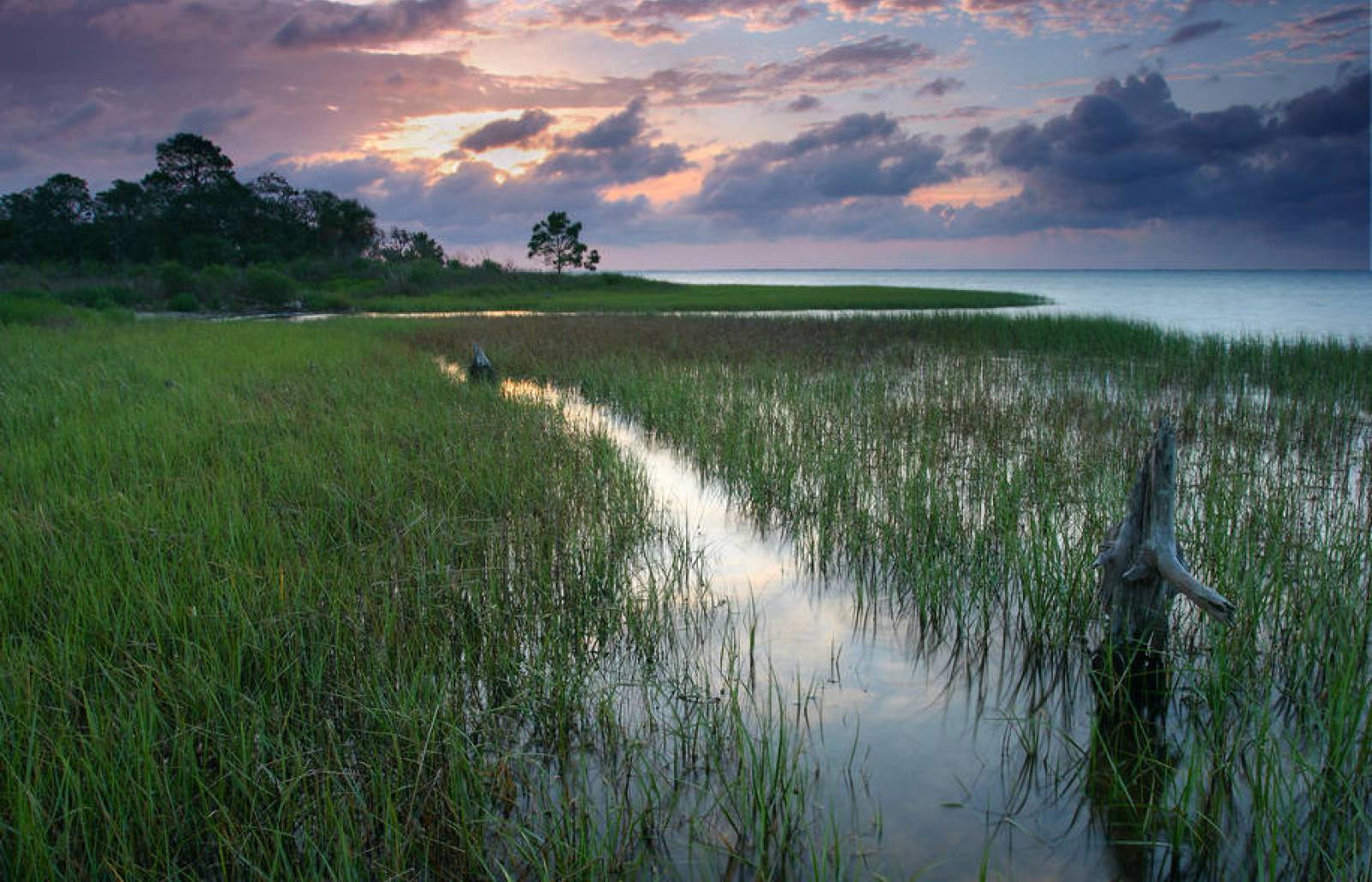
These herbaceous and shrubby
wetland communities occur statewide in brackish waters along protected low
energy estuarine shorelines of the Atlantic and Gulf coasts. The largest
continuous areas of salt marsh occur north of the range of mangroves, and
border tidal creeks, bays and sounds. Salt marshes are sometimes interspersed
within mangrove areas, and also occur as a transition zone between freshwater
marshes and mangrove forests such as in the Ten Thousand Islands area along the
southwest Florida coast. Plant distribution within salt marshes is largely
dependent on the degree of tidal inundation, and many large areas are
completely dominated by one species. Generally, smooth cordgrass typically
occupies the lowest elevations immediately adjacent to tidal creeks and pools,
while black needlerush dominates less frequently inundated zones. The highest
elevations form transitional areas characterized by glasswort, saltwort,
saltgrass, sea ox-eye daisy, marsh elder, and saltbush. For the purposes of
this project, cordgrass, needlerush, and transitional or high salt marshes are
collectively mapped as this single category.
These wetland
communities are dominated by a wide assortment of herbaceous plant species
growing on sand, clay, marl, and organic soils in areas of variable water
depths and inundation regimes. Generally, freshwater marshes occur in deeper,
more strongly inundated situations and are characterized by tall emergents, and
floating leafed species. Freshwater marshes occur within depressions, along
broad, shallow lake and river shorelines, and are scattered in open areas
within hardwood and cypress swamps. Also, other portions of freshwater lakes,
rivers, and canals which are dominated by floating-leaved plants such as lotus,
spatterdock, duck weed, and water hyancinths are included in this category. Wet
prairies commonly occur in shallow, periodically inundated areas and are
usually dominated by aquatic grasses, sedges, and their associates. Wet
prairies occur as scattered, shallow depressions within dry prairie areas and
on marl prairie areas in south Florida. Also included in this category are
areas in Southwest Florida with scattered dwarf cypress having less than 20
percent canopy coverage, and a dense groundcover of freshwater marsh plants.
Marshes and wet prairies are dominated by various combinations of pickerel
weed, sawgrass, maidencane, arrowhead, fire flag, cattail, spike rush, bulrush,
white water lily, water shield, and various sedges. Many marsh or wet prairie
types, such as sawgrass marsh or maidencane prairie, have been described and
so-named based on their dominant plant species.
These regularly inundated wetlands form
a forested border along large rivers, creeks, and lakes, or occur in
depressions as circular domes or linear strands. These communities are strongly
dominated by either bald cypress or pond cypress, with very low numbers of
scattered black gum, red maple, and sweetbay. Understory and ground cover are
usually sparse due to frequent flooding but sometimes include such species as
buttonbush, lizard's-tail, and various ferns.
back to top
These wooded wetland communities are
composed of either pure stands of hardwoods, or occur as a mixture of hardwoods
and cypress. This association of wetland-adapted trees occurs throughout the
state on organic soils and forms the forested floodplains of non-alluvial
rivers, creeks, and broad lake basins. Tree species include a mixed overstory
containing black gum, water tupelo, bald cypress, dahoon holly, red maple,
swamp ash, cabbage palm, and sweetbay.
These hardwood swamps contain broadleaf
evergreen trees that occur in shallow, stagnant drainages or depressions often
found within pine flatwoods, or at the base of sandy ridges where seepage
maintains constantly wet soils. The soils which are usually covered by an
abundant layer of leaf litter, are mostly acidic peat or muck which remain
saturated for long periods but over which little water level fluctuation
occurs. Overstory trees within bayheads are dominated by sweetbay, swamp bay,
and loblolly bay. Depending on the location within the state, other species
including pond pine, slash pine, blackgum, cypress, and Atlantic white cedar
can occur as scattered individuals, but bay trees dominate the canopy and
characterize the community. Understory and groundcover species may include
dahoon holly, wax myrtle, fetterbush, greenbriar, royal fern, cinnamon fern,
and sphagnum moss.
Shrub swamps are wetland communities
dominated by dense, low-growing, woody shrubs or small trees. Shrub swamps are
usually characteristic of wetland areas that are experiencing environmental
change, and are early to mid-successional in species complement and structure.
These changes are a result of natural or man-induced perturbations due to
increased or decreased hydroperiod, fire, clear cutting or land clearing, and
siltation. Shrub swamps statewide may be dominated by one species, such as
willow, or an array of opportunistic plants may form a dense, low canopy.
Common species include willow, wax myrtle, primrose willow, buttonbush, and
saplings of red maple, sweetbay, black gum, and other hydric tree species
indicative of wooded wetlands. In northern Florida, some shrub swamps are a
fire-maintained subclimax of bay swamps. These dense shrubby areas are
dominated by black titi, swamp cyrilla, fetterbush, sweet pepperbush, large
gallberry, and myrtle-leaf holly.
These dense, brackish water swamps
occur along low-energy shorelines and in protected, tidally influenced bays of
southern Florida. This community is composed of freeze-intolerant tree species
that are distributed south of a line from Cedar Key on the Gulf coast to St.
Augustine on the Atlantic coast. These swamp communities are usually dominated
by red, black, and white mangroves that progress in a sere from seaward to
landward areas, respectively, while buttonwood trees occur in areas above high
tide. Openings and transitional areas in mangrove swamps sometimes contain
glasswort, saltwort, and other salt marsh species. All three major species of
mangroves are mapped as a single class with no effort made to differentiate
these species into separate zones.
back to top
These wetland forests are
composed of either pure stands of hardwoods, or occur as a mixture of hardwoods
and cypress. This association of wetland-adapted trees occurs throughout the
state on organic soils and forms the forested floodplains of non-alluvial
rivers, creeks, and broad lake basins. Tree species include a mixed overstory
containing black gum, water tupelo, bald cypress, blue beech, and swamp ash.
This community is comprised of
the open water areas of inland freshwater lakes, ponds, rivers and creeks, and
the brackish and saline waters of estuaries, bays, and tidal creeks, the Gulf
of Mexico, and the Atlantic Ocean.
These are upland communities where the
predominant vegetative cover is very low growing grasses and forbs on
intensively managed sites such as improved pastures, lawns, golf courses, road
shoulders, cemeteries, or weedy, fallow agricultural field, etc. This very
early successional category includes all sites with herbaceous vegetation
during the time period between bare ground, and the shrub and brush stage.
his association includes a
variety of situations where natural upland community types have been recently
disturbed through clear-cutting commercial pinelands, land clearing, or fire,
and are recovering through natural successional processes. This type could be
characterized as an early condition of old field succession, and the community
is dominated by various shrubs, tree saplings, and lesser amounts of grasses
and herbs. Common species include wax myrtle, saltbush, sumac, elderberry, saw
palmetto, blackberry, gallberry, fetterbush, staggerbush, broomsedge, dog
fennel, together with oak, pine and other tree seedlings or saplings.
Upland and wetland areas
dominated by non-native trees that were planted or have escaped and invaded
native plant communities. These exotics include melaleuca, Australian pine,
Brazilian pepper, and eucalyptus.
This class includes highly reflective unvegetated areas such as roads,
beaches, active strip mines, tilled agricultural sites, and cleared land on
sandy soils. Unvegetated sites in urban areas which include rooftops of
buildings, athletic fields, landfills, and parking lots, etc., are also
included in this category. Vegetated tracts within urban areas are classified
and mapped according to their predominate vegetation cover or plant community
type.
back to top