Common Plant Communities in Northwest Florida
Wetlands
Cypress domes and cypress strands (also known as stringers in North
Florida)
– usually found in flatwoods and savanna landscapes, examples with
public access can be found in the Apalachicola National Forest.
Hydric Hammock – found in coastal counties, especially Wakulla
and Taylor counties. Examples on public lands can be seen in the St.
Mark National Wildlife Sanctuary.
Hydric pine flatwoods – scattered throughout the area, public
access can be found in the Apalachicola National Forest.
Bayhead – Throughout, public access can be found in the
Apalachicola National Forest.
Seepage slope/bog – Throughout, public access can be found in
the Apalachicola National Forest and Blackwater River State Forest.
Floodplain forest/marsh/stream
flora – Throughout, includes alluvial streams and blackwater
streams, includes some ravine flora (at least in part). Good examples
with public access are found in the following areas: Apalachicola
National Forest, Blackwater River State Forest, Marianna Caverns State
Park and Torreya State Park. Also various public boat ramps usually
contain remnant floodplain forest. See the our webpage for an
illustrated guide to floodplain trees in north Florida.
Slough - these are the shallow streams that typically run
through Savannas – found in areas with low relief depending on
plant composition, associated with cypress stringers. Good examples
with public access are found in the Apalachicola National Forest.
Depression marsh – Throughout, interdunal swales are included
in this designation as they are floristically related to freshwater
marshes. Good examples with public access are found in the
Apalachicola National Forest.
Lakeshore marsh/swamp – Throughout. Good examples with public
access are found at public boat ramps associated with Lake Jackson
(Leon County) and Lake Overstree and Lake Hall within Maclay State
Gardens (Leon County).
Spring-run – includes floodplains/river marsh in part – found
wherever there are springs. One of the best area to explore these
unqiue areas is in the Wakulla Springs State Park along the hiking
trail.
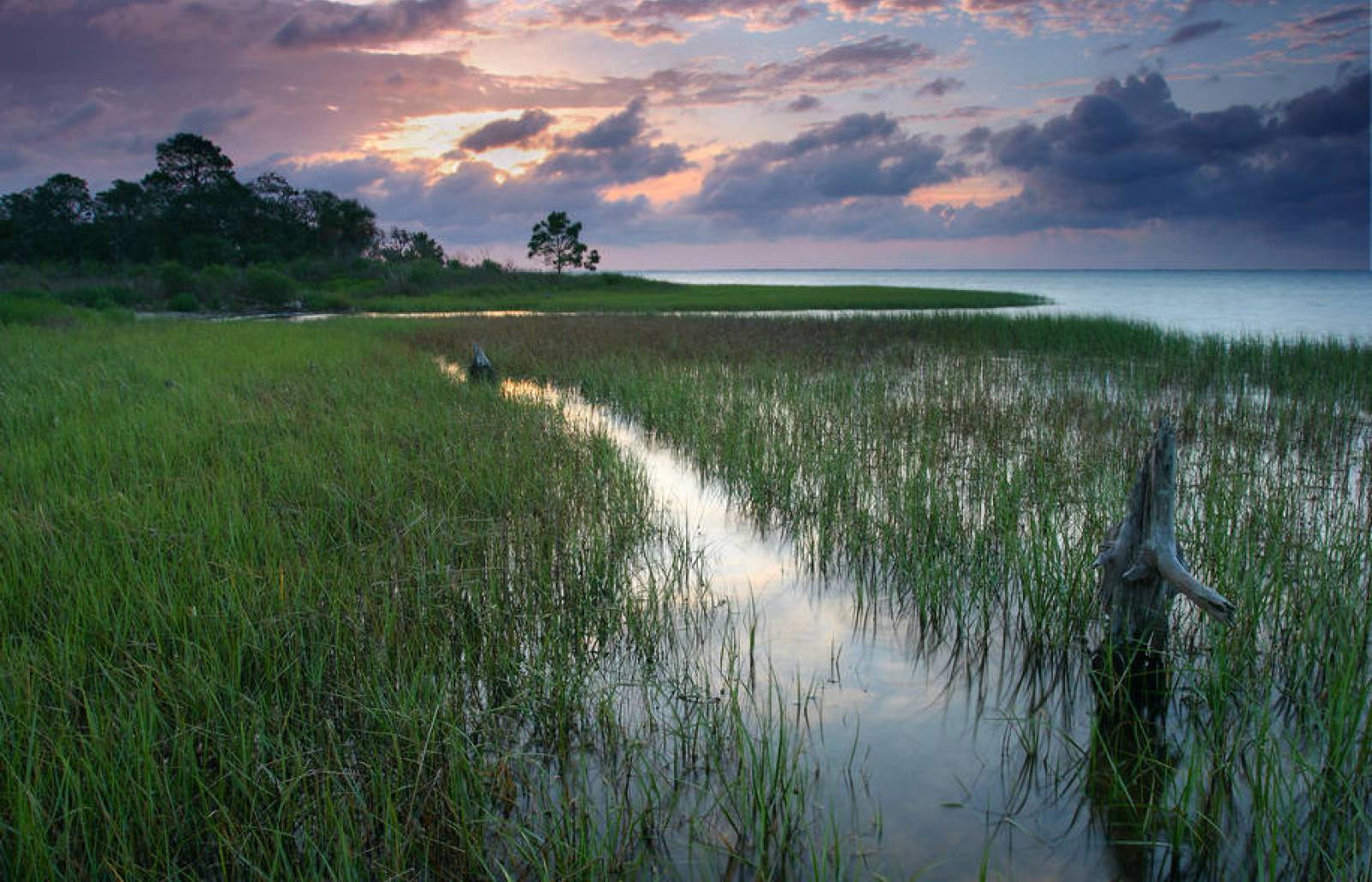
Salt marsh – locally common in coastal areas, includes
hypersaline flats which occur within the marsh. Examples on
public lands can be seen in the St. Mark National Wildlife Sanctuary,
St. Joseph Peninsula State Park, St. George Island State Park and
Grayton Beach State Recreation Area. See the our webpage for an
illustrated guide to saltmarsh plants of north Florida.
Freshwater swamps - a "catch-all" that in its broadest sense
includes all freshwater forested wetlands such as titi swamps, red
maple swamps, tupelo swamps, and an infinite variety of successional/disturbed
swamps. Good examples with public access are found in the Apalachicola
National Forest and Blackwater River State Forest.
Uplands
Sandhill – throughout, examples with public access can be
found in the Apalachicola National Forest, Blackwater River State
Forest, and Torreya State Park.
Coastal Scrub – locally common along the coast (rapidly being
destroyed in northwest Florida), usually associated with beach dune
and coastal hammocks. Examples with public access can be found in St.
Joseph Peninsula State Park, St. George Island State Park, Grayton
Beach State Recreation Area.
Xeric Hammock/Coastal Hammock - locally common along
the coast (rapidly being destroyed in northwest Florida), usually
associated with beach dune and coastal scrub. Examples with public
access can be found in Gulf Islands National Seashore, Naval Live Oaks
(part of Santa Rosa Island National Seashore) St. Joseph Peninsula
State Park, St. George Island State Park, Grayton Beach State
Recreation Area.
Beach dune - locally common along the coast (rapidly being
destroyed in northwest Florida), usually associated with beach scrub
and coastal hammocks. Examples with public access can be found in St.
Joseph Peninsula State Park, St. George Island State Park, Grayto
Beach State Recreation Area.
River bluff forest – associated with the larger rivers in
northwest Florida; examples with public access can be found in the
Apalachicola National Forest and Torreya State Park.
Mixed mesophytic - forest these are the climax forests with
high tree diversity, generally related to the beech-magnolia forest
type. Examples with public access can be found in Torreya State Park
and Marianna Caverns State Park.
Upland mixed forests this is a catch-all to include all other
variations of upland forest that might be successional in nature or
subclimax types due to fire, soil or other environmental conditions.
Pine flatwoods – found throughout the area, examples with
public access can be found in the Apalachicola National Forest.