What is a Wetland?
There are many definitions of wetlands, and many kinds. In the most general of terms, a wetland is a
natural community where water is at or covering the surface of the ground for all or part of the
year. The key in this definition is the term natural community, which helps to exclude temporary
standing floodwaters from being designated as wetlands.
Other definitions are more specific and technical and-- because the definition establishes what
property is or is not subject to regulations by federal, state, or local environmental
agencies--often controversial.
For instance, defining a wetland as land that contains "standing water" for at least 15 consecutive
days out of any year, may bring a smaller area of land under regulation than one which merely says
the soil must be wet for seven days. And definitions that set requirements for "consecutive" days of
inundation also exclude many kinds of wetlands which are created by frequent but short-term
flooding.
Here are two other definitions of wetlands:
Those areas that are inundated or saturated by ground or surface water at a
frequency or duration sufficient to support, and that under normal circumstances
do support, a prevalence of vegetation typically adopted for life in saturated
soil conditions.
Wetlands are lands transitional between terrestrial and aquatic systems where the water table is
usually at or near the surface or the land is covered by shallow water. For purposes of this
classification, wetlands must have one or more of the following three attributes; (1) at least
periodically, the land supports predominately hydrophytes; (2) the substrate is predominately undrained hydric
soil; and (3) the substrate is non-soil and is saturated with water or covered
by shallow water at some time during the growing season of each year.
There are other definitions, many of them more complex than any we have cited here.
In Florida, wetlands are defined by looking at the kinds of plants that predominate in them, by
soils, and by use of hydrologic indicators.3 Persons who are regulated by the Department of
Environmental Protection follow the Department's development of the rules that list these criteria
with great care.
Kinds of Wetlands
Coastal Wetlands
Mangrove Forests or Swamps
Large areas along the coast of southern Florida are covered by dense forests of mangroves. On
Florida's east coast, mangroves reach north into the vicinity of St. Augustine--the northeastern
limit of the black mangrove (Avicennia germinans). Mangrove swamps are found intermittently
southward, through the Florida Keys, and up the West Coast of Florida to the limit of the red
mangrove (Rhizophora mangle) in Levy County. Black mangroves are scattered around the Gulf Coast to
Mexico.
Mangrove forests occur along protected tidal rivers and creeks, and in bays and estuaries.
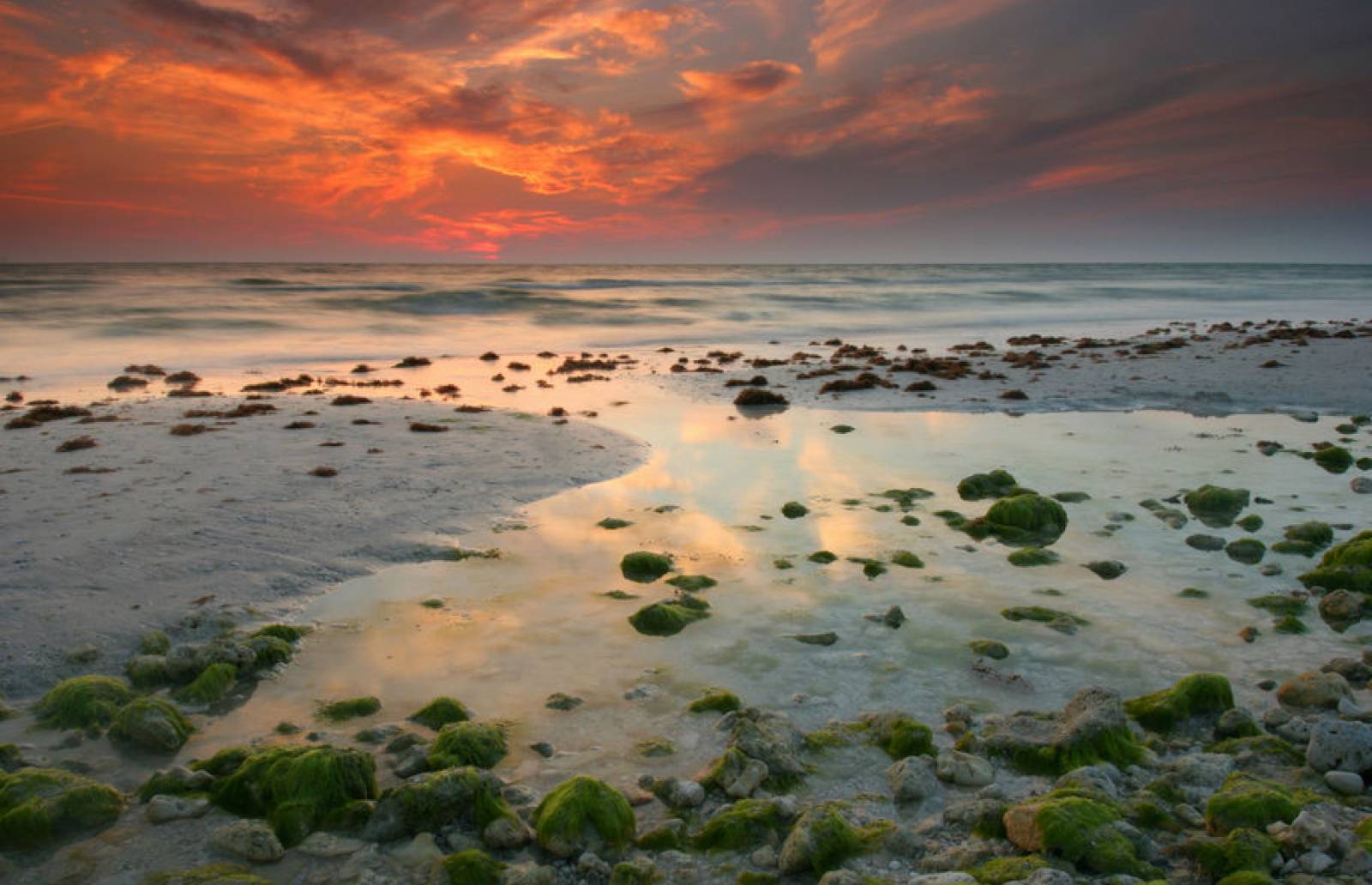
Saltwater Marshes
Most coastal wetlands in the United States and many of the coastal wetlands in Florida are salt
marshes. Salt marshes are marked by the preponderance of various grass-like plants--cordgrass (Spartina
alterniflora and others) and rushes (Juncus romerianus). Vast areas of Florida's big bend coastal
areas are covered by salt marsh. Salt marshes prosper to the north of the mangrove forests.
Saltwater marshes are found inside lagoons formed by barrier islands, such as near St. Augustine,
and along low-energy beaches such as the Florida Big Bend.
Fresh Water Wetlands
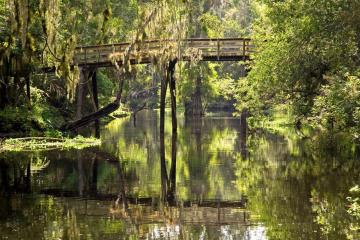
Forested fresh water swamps
Forested wetlands line the floodplains of rivers and streams throughout Florida, and ring its lakes.
Noticeable trees in a forested fresh water wetland include the bald or pond cypress (Taxodium
distichium or T. ascendens), water tupelo (Nyssa aquatica), and the red maple, (Acer rubrum). Other
plants include aquatic plants such as water lilies (Nymphaea sp.), arrowroot (Thalia sp.),
understory plants and shrubs such as the cabbage palm (Sabal palmetto) and willows (Salix), and
various ferns.
The floodplain along the Apalachicola River in North Florida, and Big Cypress Swamp in South Florida
west of the Everglades are examples of forested wetlands. Cypress domes are common throughout
Florida.
Fresh water marshes
Fresh water marshes are found in low areas throughout Florida. They may include open water, and are
covered with various grasses and aquatic plants. Typical plants in a fresh water marsh include
sawgrass (Cladium jamaicens) in South Florida, spike rush (Elecharis cellulosa), panic grass (Panicum
lacustre), water lily (Nymphaea sp.), and pond weed (Potamogeton sp.).
The most famous of Florida's fresh water marshes is the vast Everglades in South Florida.
The
Importance of Wetlands
We tend to value objects in nature in direct relation to what we think those objects can "do" for
us. Early explorers in Florida spoke of worthless, fever-ridden swamps, fit only for mosquitoes,
snakes and alligators. The history of Florida is one of draining its "worthless" swamps for
agriculture and development. Since statehood, Florida has lost half--nearly ten million acres--of
its wetlands.
Only late in this century, as our wetlands were vanishing at an alarming rate, did we begin to
realize that they truly can "do" something for us.
Some of these include:
Water quality and water conservation -- Wetlands help to filter damaging nutrients and other
pollutants from the water that passes through them. They store floodwaters and can help recharge
ground water.
Flood and storm protection -- Wetlands are streamside buffers against the eroding fury of floods.
Along the coast, they stabilize shorelines and protect homes and property from storm surge and
flooding.
Habitat for birds and other wildlife -- Ducks, geese, and other migratory birds; endangered species
(including the American eagle, the Florida panther, and the snail kite); and the survival of many
commercial species of fish and shellfish--such as shrimp and crabs--depend upon healthy fresh water
and coastal wetland systems.
Aesthetics -- Some of Florida's most beautiful and striking vistas are across wetlands--in the
Everglades, or along the long coastline.
The economic value of wetlands is indisputable. Acre-for-acre, wetlands are more productive than
many agricultural lands. Florida's sports and commercial fisheries are dependent upon healthy
wetland ecosystems. Wetlands bring in tourism dollars from hunters, fishermen, campers and
boaters--as well as from those who merely want to look at, photograph, or paint them.
Protecting Wetlands
Florida has an active program to protect its wetlands. Any activity which may damage a wetland may
be conducted only after stringent environmental review and under a permit issued by the Florida
Department of Environmental Protection or one of Florida's water management districts.
Anyone who is considering an activity which could affect a wetland in Florida should first contact
the Florida Department of Environmental Protection's Division of Environmental Resource Permitting
at (904) 488-0130 or their regional water management district.
How You Can Help
If you live on a waterfront, use a swale and berm system to keep runoff that might contain lawn and
garden pesticides and fertilizers from running off into the water.
Avoid building sea walls or other armored structures.
If you must trim waterfront mangroves for a water view, do so only in accordance with state and
local regulations.
Reduce or eliminate the use of chemical fertilizers and pesticides. Landscape with native plants;
they require fewer applications of pesticides or fertilizer--and also less water.
Build the smallest dock you can to avoid adverse effects on the near-shore wetlands.
If a central sewer system is available, use it. Septic tanks can leach into waterways, adding
nutrients that promote noxious aquatic plant growth.
NOTES:
Preliminary Guide to Wetlands of Peninsular Florida, U.S. Army Corps of Engineer Waterway Experiment
Station, Vicksburg, Miss. February 1978.
Classification of Wetlands and Deepwater Habitats of the United States, U.S. Fish and Wildlife
Service, USDI. December 1979.
Chapter 62-340, Florida Administrative Code.
Adapted from Preliminary Guide to Wetlands of Peninsular Florida, op. cit.
For Further information, call the Department of Environmental Protection, Office of Environmental
Education, tel. (904)488-9334. Our address is 3900 Commonwealth Blvd. MS-30, Tallahassee Florida
32399-3000. You also may dial the Florida DEP's Ecosystem Management and Environmental Education BBS
at (800) 217-2934 using standard 8-N-1 communications settings and ANSI terminal emulation.