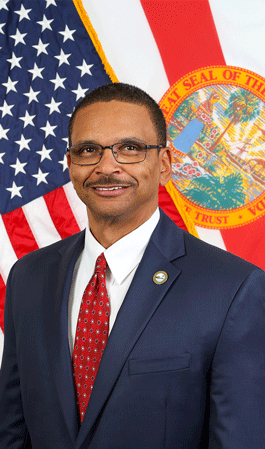

Secretary Hamilton has worked at the Florida Department of Environmental Protection since 2007, where he has risen through the ranks of the department. Early in his career he served as ombudsman and public affairs manager in DEP’s Northwest District Office. He was promoted to assistant district director in 2010 and was appointed district director in 2011 and was subsequently promoted to interim deputy secretary of Land and Recreation in 2020 and formally appointed as deputy secretary in 2021.
Secretary Hamilton has 20 years of experience in the public and private sectors, where he has proven to be an effective and driven leader with the ability to influence and build trusted and constructive connections with community stakeholders, elected and appointed municipal officials, and organizational team members.
He served as the agency’s environmental justice coordinator with responsibility for providing statewide guidance on sensitive environmental justice issues and was appointed as the principal state liaison for the U.S. Environmental Protection Agency’s Office of Environmental Justice.
Secretary Hamilton had provided effective leadership, incident command, and focused recovery during multiple large-scale natural and industrial emergencies to include Deepwater Horizon oil spill, International Paper Mill explosion, and hurricanes Irma and Michael.
He also led the creation and execution of reoccurring partnership meetings with the U.S. Air Force, U.S. Navy, Gulf Power, Emerald Coast Utilities and Escambia County.
Secretary Hamilton has a bachelor’s degree in computer science from Troy State University with a minor in business. He and his wife Charlene have three sons, Christopher, Brandon and Joshua.
The secretary works alongside more than 2,900 full-time and 1,300 OPS employees to protect Florida's water and natural resources. Along with oversight of the agency's strategic and executive leadership teams, DEP's regulatory programs, ecosystem and restoration programs and land and recreation programs.
The secretary oversees all functions of the department:
Interested in subscribing to DEP newsletters or receiving DEP updates through email?
Sign UpThe Florida Department of Environmental Protection is the state’s lead agency for environmental management and stewardship – protecting our air, water and land. The vision of the Florida Department of Environmental Protection is to create strong community partnerships, safeguard Florida’s natural resources and enhance its ecosystems.
Learn More