Florida's Geologic History
The Earth is more than 4.5
billion years old! During this unimaginable
expanse of time our planet has undergone drastic
changes. For the earliest part of Earth’s
history the planet was a molten inferno. As
the planet slowly cooled, rocks and minerals began
to form and continents and ocean basins took shape.
Earth’s continents today look nothing like they did
hundreds of millions of years ago. In fact,
the continents move around through a process called
plate tectonics. Continental crust (the thin
outer skin of our planet) sits on top of hot rock
material, called the mantle, which behaves like cold
syrup . As the plates shift they can collide,
causing mountain ranges and deep ocean trenches, and
they can slide past one another along long faults,
like the San Andreas fault, and they can spread apart
as seen along mid-ocean ridges. Plate
tectonics describes the processes involved in plate
motions and allows geologists to understand how
Earth’s plates, of which Florida is a part, came to
be.
The geological history of
Florida can be traced back to the Paleozoic
Era, 540 – 251 million years ago (mya) based upon
rock core samples retrieved from thousands of feet
below the surface. These rocks, referred to as
basement rocks, consist of igneous and metamorphic
suites overlain by sandstones and shales.
These sequences of rocks record the events that were
taking place as the Laurentian and Gondwanan
landmasses were converging to create the
supercontinent of Pangea. As these and other smaller
landmasses converged they would create the
foundation for the accumulation of vast thicknesses
of carbonate (limestone) which would eventually
become the Florida Platform.
During the early Mesozoic
Era (251 – 65.5 mya) the supercontinent of Pangea
began to rift and break apart. At this time,
Florida was located between what would later become
the continents of Africa, South America and North
America. In fact, as North America separated
from Africa a small portion of the African plate
remained “stuck” to North America and that provided
some of the foundation upon which Florida now rests.
Geologists can tell this by looking at the chemistry
and fossil assemblage of Florida’s basement rocks.
During the later part of the Mesozoic Period,
Florida’s landmass was beneath a warm, shallow
ocean. As marine organisms died and sank to
the ocean floor they began to accumulate in great
thickness. This sediment would later become
limestone.
The end of the Mesozoic
Era was brought about by a great cataclysm – a
large meteor impact in what is now the Yucatan
Peninsula. This event, it is thought, was
catastrophic enough to cause mass extinction and
probably brought about the demise of the dinosaurs.
Although there are rocks of this age in Florida,
there is no evidence of the impact in the rock
record here. Whatever debris might have been
deposited on the Florida Platform was eroded away at
a later time.
During the Cenozoic
Era (65.5 mya – present) Florida slowly took its
current shape. Warm, tropical oceans still
covered the state until the Late Oligocene Epoch
(28.4 – 23 mya). Limestone comprised of the
skeletons of billions of small creatures called
foraminifera accumulated. Large, voracious
whales roamed our shallow seas hunting other marine
vertebrates. Small patch reefs formed in the
warm, clear, shallow waters of Florida during this
time. Also during this time period a marine
current, very similar to the Gulf Stream, swept
across northern Florida and scoured the sea floor.
This current deflected sediment that was being
eroded and transported from the main land.
This is the reason why limestones from this time
period in Florida are so pure (up to 99% calcium
carbonate).
At the end of the
Oligocene Epoch, sea levels dropped and Florida
emerged from the sea. The first fossils of
terrestrial vertebrates come from this time period
and include animals like bats, horses and
carnivores. From this point on at least some
portion of Florida would remain above sea level.
It is primarily the interaction between land and the
ocean that has sculpted the landforms of Florida.
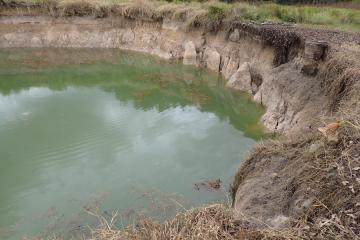
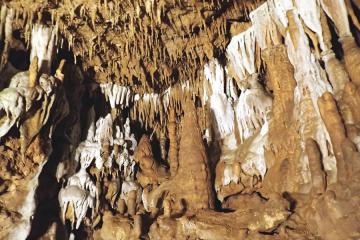
Karst refers to features that have formed as the
result of dissolution of rock material.
Limestone, which underlies all of Florida, is able
to be dissolved by slightly acidic rain water.
Over geologic time (millions of years) large pore
spaces, conduits and caverns can form. As the
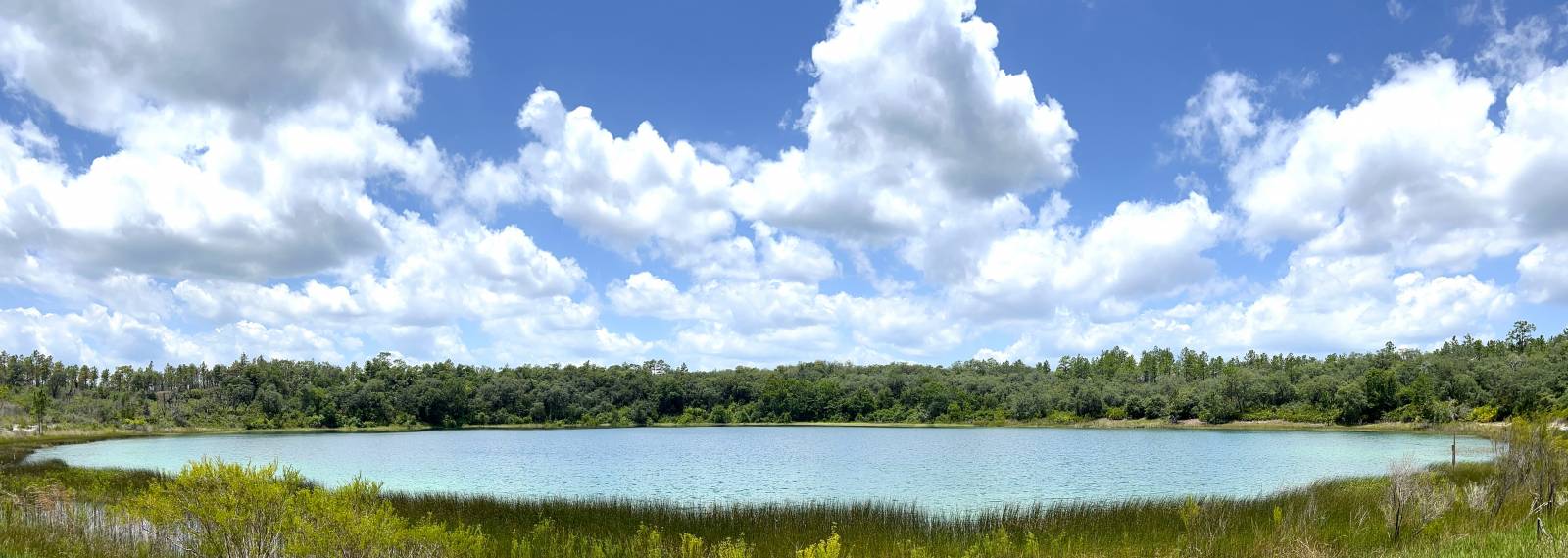
land surface collapses into these voids, sinkholes
form. Sinkholes are a prominent feature in the
Florida landscape. Other karst features
include springs, air caves and disappearing streams.
Throughout the end of
the Oligocene and into the Miocene, sea-levels
fluctuated and clays and sands became common
deposits. The Miocene Epoch (23 – 5.3 mya) was
a time of unique conditions across Florida.
In the Early Miocene, the
Appalachians were uplifted, erosional rates
increased, and continental siliciclastic sediments
filled the Gulf Trough. Siliciclastic sediments
began encroaching southward upon the carbonate
depositing environments. Large deposits of phosphorite accumulated as cool,
nutrient-laden ocean water bathed Florida.
These deposits are mined today and account for a
significant portion of the phosphate produced in the
United States. Unique creatures also existed
in Florida at this time. Large sharks
patrolled the near-shore marine environments preying
on whales. Horses, saber-toothed cats and
elephants roamed the land. Many
of these creatures left behind their bones in
Miocene deposits. A prized fossil from this
time period is the tooth from the giant extinct
Caracharodon megalodon
shark. These teeth can exceed six inches in
length and belonged to an animal that may have been
fifty feet long!
The Pliocene Epoch (5.3 –
2.6 mya) was an important time for land animals in
Florida. North America became connected to
South America and allowed animals from both
continents to travel freely between them. North
America became the home to animals like sloths,
giant armadillos and llamas that migrated north over
the newly formed connection. Ocean currents
were also interrupted and the Gulf of Mexico became
isolated from the influence of the Pacific.
The exchange of flora and fauna from South America
is known as the Great American Interchange.
Sea levels were fluctuating and marine deposits
(limestone and shell beds) were accumulating in
south Florida. Some of the most diverse
molluscan faunas in the world accumulated in
southwest Florida during this time.
The Pleistocene Epoch
(2.6 mya – 10,000 years ago), also known as the Ice
Age, was a time of extreme climate and sea-level
change. Sea levels were as much as 300 feet
lower and as much as 100 feet higher than today.
As the giant continental glaciers advanced and
retreated, sea-levels responded by falling and
rising. During warm, interglacial periods, sea
levels were sufficiently high to allow marine
limestones to accumulate. During glacial
periods, sea levels were much lower and erosion and
dissolution of limestone occurred. Giant
ice-age mammals roamed Florida at this time and
included some of the largest land mammals to have
ever existed. Some of these animals include
mammoths, mastodons, giant lions, Dire wolves,
saber-tooth cats, giant sloths and giant beavers.
At the end of the Pleistocene another animal arrived
in Florida – man. This also coincided with the
demise of the giant ice-age mammals. Many
large mammals went extinct at the end of the
Pleistocene either as the result of climate change,
human hunting or a combination of both.
During the Holocene Epoch (10,000 years ago –
present), sea level reached its current elevation.
Human populations expanded and shaped the landscape
to suit their needs. The Everglades of south
Florida formed and thick layers of peat were
deposited. The Keys became
islands
and new coral reefs began to grow. Our modern
climate developed and Florida took the shape we are
all used to seeing – a long peninsula.
Contributed by Guy H. Means.
Download
a
Quicktime
animation of Florida's tectonic history
Download
an evaluation copy of Quicktime for Windows
(version 4.1.2, Copyright© 1993-2000 Apple
Computer, Inc. All rights reserved).
Download
a Quicktime animation of Florida's ancient
geography through geologic time
Note:
The graphic to the right explains the colors in
the animation. The numbers in this legend refer
to meters above or below sea level.
Suggested
reading:
- Lane,E. (editor), 1994, Florida's Geological History
and Geological Resources, FGS Special Publication
35, 76 p.