Florida Geological Survey's Mission:
Collect, interpret and provide objective quality geologic information about Florida.
back to list
The Survey’s Administrative and Geological
Data Management Section staff includes the
Administrative Assistant to the State Geologist, the
Business Manager, an Operations and Management
Consultant, the Geological Data Management staff
comprised of GIS and data management professionals, and
the Survey Librarian. This section is responsible for
administration (budget, department and interagency
liaison, etc.) and personnel management (travel, leave,
benefits, etc.), Gunter Building maintenance and repair,
and contract and grant tracking. Section staff work
closely with grant administrators in each of the other
FGS sections to assure compliance with DEP purchasing,
budget, and personnel management guidelines, and assist
in budget and timeline tracking of grant projects.
The
Geologic Investigations Section
back to list
The Geological Investigations Section of the Florida Geological Survey
collects and interprets surface and subsurface geologic data to provide
an understanding of Florida's three-dimensional geologic framework. This
knowledge is necessary to understand Florida's ecosystems, watersheds,
aquifer recharge and protection, and effective environmental
remediation. Research conducted by the Geologic Investigations section
includes statewide geologic and geomorphic mapping, aquifer-system
framework delineation, and research in stratigraphy, paleontology, and coastal geology.
The Geological Investigations Section staff also act as consultants to or
co-investigators with other local, state and federal agencies, and
function as FGS District Geologists with expertise on the geology of
each of the state's five water management districts as well as DEP's regulatory
districts.
The Geological Investigations Section is comprised of three program areas.
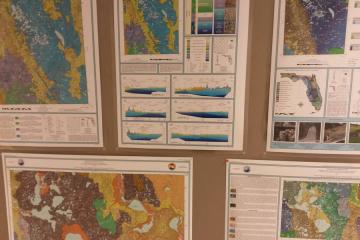
The Geological Mapping and Assessments Program
staff conduct detailed statewide geological
mapping projects funded by the federal STATEMAP
program. The program assists with in-house GIS
geological and hydrogeological mapping projects
and maintains the statewide Subsidence Incident
Report database. Program staff may provide
geological assessment services to other FGS
sections and various agencies
within DEP. Other program focus areas
include geological
hazards, environmental studies,
FGS
publication production, geological education
activities, and public outreach. The
program staff work closely with the Geological and
Geotechnical Data Acquisition Program
in describing well cores
and cuttings from both new wells and
older wells archived in the FGS core repository.
The Geological and Geotechnical
Data Acquisition Program acquires geological data and samples through
auger and core-drilling supporting existing FGS
research, such as the statewide mapping program.
Several of these coring projects have supported
other DEP programs such as the Ambient
Groundwater Monitoring program, Florida Parks,
and U.S. Geological Survey hydrogeology projects
in southwest Florida and the Everglades
Ecosystem Restoration. The descriptions are
entered into the FGS lithologic database, which
presently contains approximately 5,000 entries.
Cores, cuttings, lithologic descriptions and
geophysical logs are an invaluable asset to the
earth science community. This fundamental
geologic data supports needs of more than one
third of the programs in the Florida Department
of Environmental Protection.
Coastal research activities within the section are partially funded by various
Federal agencies including the U. S. Geological Survey, the
Bureau of Ocean Energy Management, Regulation, and Enforcement, and the Environmental Protection Agency.
The coastal studies were initiated in 1991 in
recognition of the need for geologic information to further our understanding of
coastal processes, resources and fragile coastal ecosystems. Current
projects include offshore sand resource assessments for potential beach renourishment,
development of a sand atlas detailing the characteristics of beach sands around
the state, and side-scan sonar mapping of near-shore coastal areas.
back to list The Applied Geoscience
Services Section’s responsibilities are to generate, analyze,
interpret and disseminate hydrogeological data and information to
decision makers at all levels of government, academia, the consulting
community and the public at large. Such data is generated through
scientific research supported by federal grants and conducted by Section
scientists, frequently in collaboration with other scientists in the
university system and the private sector with close supervision by the
Section’s project managers. This approach continues to produce unbiased,
scientific information about Florida’s environment, its water resources
and ecosystems. Such information is being put to good use in making land
and water use decisions by local and State agencies. Critical to
achieving the Section’s objectives is bridging the gap between basic and
applied science by directing research to solving real societal problems
in such areas as: The dynamics of heavy interaction between ground and
surface water, developing predictive models for ground water flow and
contaminant transport, evaluating the ecological impacts of sea level
rise, determining aquifer vulnerabilities, evaluating the impacts of
Aquifer Storage and Recovery, identifying geological formations suitable
for carbon sequestration and geothermal energy generation. Basing
decision-making and problem-solving on scientific data, will help
streamline regulatory processes by eliminating redundancies and
un-necessary requirements. This, in turn, can help in creating a better
balance between environmental protection on the one hand and job
creation and economical well being on the other.
The section is divided into two working programs,
Hydrogeology and Geoscience Information.
The Hydrogeology program is actively involved in a number of data
acquisition and analysis projects statewide. The Geoscience
Information program includes the Geographic Information System and
database management staff as well as the Survey Librarian.
The State of Florida faces
serious issues concerning the availability and
use of land, water, energy, and mineral
resources, and the overall stewardship of the
environment. Continuing population growth and
associated development consumes natural
resources and puts constant pressure on water
resources conservation and land-use or planning
management schemes. How will we provide an
adequate supply of building materials for our
infrastructure and other critical resources for
the future? How can we stem the tide of land
clearance and natural environment alteration as
development continues? How can we best prepare
for the natural hazards that will continue to
occur such as coastal erosion, sinkholes, flood
prone areas, swelling clays, mercury or radon
accumulation, etc.? How do we respond to
endangered species concerns or ecosystem
degradation if we don't understand the basic
building blocks (namely the solid earth geologic
framework) of Florida's environments?
An effective response to these
questions and similar concerns depends on
continually increasing our knowledge about the
solid earth structure, resources, and the
fundamental dynamics of the earth systems that
continually modify and change our environments.
As development pressures increase, the need for
detailed quality data becomes more important.
The Florida Geological Survey provides
scientific information required to address these
issues. This information is essential for public
and government officials to make informed
decisions concerning the wise use of our finite
natural resources and for the protection and
conservation of our environments. Our standard
of living, our state's economic future, indeed,
even our national security depends on our
knowledge of the earth.
Staff of the FGS are in constant
professional contact with many government
agencies (federal, state, regional, and local),
industry, academia, the consulting community,
and the public. In this way, research projects
and programs can be designed to provide data and
interpretations in a relevant and timely manner.
Routinely, other programs within the Department
of Environmental Protection are solicited to
provide their recommendations and issues of
concern to the FGS Director. In addition, the
"Florida Geologic Mapping Advisory Committee"
meets periodically to provide the FGS input
regarding statewide prioritization of geologic
mapping needs.
With the above guidance,
geologic projects are identified and designed to
provide the needed interpretations. Many of
these programs are joint efforts with various
levels of support from other agencies.
Hydrogeologic (mostly aquifer characterization
and properties assessments), coastal and
near-shore marine geology, environmental
geology, basic stratigraphy and lithology
correlation's, economic geology and minerals
production information, and geologic education
projects are the dominant topical areas covered.
Other subordinate projects include: selected
deep stratigraphy and petrology studies to
better understand Florida's oil and gas
resources, paleontology and paleoecology studies
to assist with the prehistorical understanding
of the Florida Platform and ecosystem change
dynamics, and the geochemistry of Florida peats
found within wetlands.
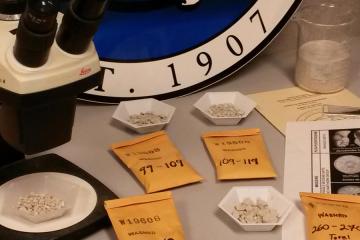
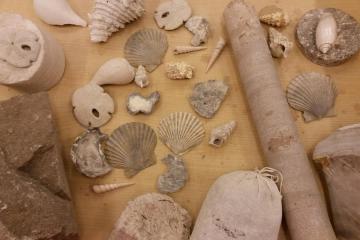
Another basic program
responsibility of the FGS is the maintenance of
a well-cuttings, core, and outcrop sample
repository. This irreplaceable resource is used
by industry, consultants, and government
scientists in support of municipal water well
placement, well-head protection support,
injection well design, aquifer protection and
recharge assessment, landfill location and
design, infrastructure and building design and
siting, land zoning decisions, mineral resource
assessments, geologic hazards mitigation, and
many other needs when solid earth information is
required.