The Florida Geological Survey
(FGS) is the only agency in the State of Florida which collects, stores,
interprets, maintains, and publishes geologic and hydrogeologic data
from throughout the State. Regional agencies, counties, and cities do
not have the data-base or the expertise to justify their own geologic
programs. They have relied on the State Geological Survey for this kind
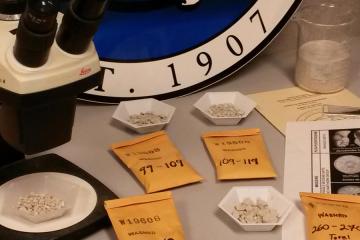
of assistance for 100 years. The FGS maintains a well- cuttings and core
repository which includes samples collected from over 18,000 drill holes
throughout the state. Academia is not the place for an applied earth
science program as proven by the experiences of all fifty states and our
collective experience from the last century. Universities (including
state universities) historically focus on teaching, and research of
interest to the current faculty which can result in peer
acknowledgement. Their organizations are not set up for long term
institutional memory and data maintenance or agency support. In
addition, because they have not historically been “applied” programs,
they have little current expertise regarding applied geologic programs
which is the forte of State Geological Surveys.
Ecosystem Management and environmental dynamics has been an
emphasis of many federal and state governmental agencies in recent years. The
Florida DEP carries out programs in environmental regulation, land-use
management and conservation, and holistic ecosystem / watershed management to
integrate science, planning, regulations, and land management practices for the
best possible program. Earth science is the foundation of all these programs.
Without fundamental geologic and hydrogeologic information and interpretations
no basic environmental understanding can be obtained! And without basic
understanding of the earth-systems involved, no regulatory or land management
plan will be successful. Any environmental regulatory or land management program
will be seriously embarrassed if it is suggested that it can implement
comprehensive ecosystem management, manage state lands and parks, and pursue
environmental regulation without the benefit of a geologic research team to
supply earth systems interpretations.
In the early 1990’s the Department of Environmental Protection conducted a wide
survey of all data base users. It was intended to begin to plan for efficient
ways to integrate the many users of the various kinds of data. 43% of the
programs stated that they needed geologic data to carry out their program
functions! The FGS has developed its geologic information through the
electronic communication media, including the INTERNET. In this way various
programs and others are able to access earth science data and interpretations
from their desktop to facilitate their job tasks.
The FGS routinely offers assistance regarding assessment of economic minerals of
various land parcels for the Division of State Lands, the Department of
Agriculture, the CARL Program, the U.S. Bureau of Land Management and several
others.
The FGS has a total of 28 FTE’s which is the only DEP earth science research
component. Knowledge of the earth materials found under our uplands (in addition
to the submerged lands) are important to our society for many reasons such as:
we grow our food on them; we extract our drinking water from them (and our
drinking water travels through them), we extract building materials from them
(including materials to build roads, dams, and buildings, etc.), we dispose of
waste in them, we are exposed to natural and societally enhanced hazards
(including coastal erosion, flood prone areas, sinkholes, pipeclays, radon,
mercury, and others). The economic impact of the earth materials and their
benefit to society throughout Florida is at least as significant as that of the
marine realm. Try to imagine our life style in Florida if the above topical
areas were not available or were lost to us because of pollution or bad
management practices.
In addition to uplands earth science pursuits, there has been identified a need
for coastal, nearshore geological investigations. Needs for such purposes as
beach restoration and inlet management have been identified by the State, the
Florida Shore and Beach Preservation Association, the Environmental Protection
Agencies’ consortium pursuing the Gulf of Mexico Program , the U.S. Geological
Survey, the U.S. Bureau of Ocean Energy Management, Regulation and Enforcement, and the U.S. Army Corps of
Engineers. State geological surveys have been identified by the Federal
Government as the lead state agencies in pursuing such investigations. The FGS
is currently involved in such coastal studies, and has commitments for
additional studies from participating Federal funding sources.
Most government programs at all levels are a fiscal drain on their tax bases.
This is not out-of-line because most government services are not designed to
make a profit, they are to provide a service to the public, hopefully using
their appropriated dollars efficiently. State Geological Surveys, however, do
provide economic benefits to the state and taxpayers. Geologic information is
used for many purposes by state and local planners (such as avoiding development
over a useful mineral deposit, avoiding costly waste clean-up by properly
locating landfills or disposal wells). It has been estimated by economists that
geologic map data provided by state geological surveys provides a payback of 7
to 55 times the initial investment! This type of assessment has also been
carried out by the federal government with the same results.
The FGS has no plant facilities financial encumbrances because of a highly
unique relationship with the Florida State University in association with the
Department of Geosciences (academic research cooperation through a “Memorandum
of Understanding”, and building deed restrictions). This translates into
significant dollars (there is no building rent) which are spent on applied
research and public service and utilized towards production of task oriented
information services for the DEP.
About twenty years ago the National Geological Mapping Act passed Congress (and
has been subsequently reauthorized) and was signed into law by the President.
This act describes the usefulness of geologic data and partnerships between
state and federal geological surveys, academia, and the private sector. Six
members of the Florida Congressional delegation were co-sponsors of the act upon
the recommendation and encouragement of the Florida State Geologist. It was also
endorsed by past DER Secretary Carol Browner, and past DNR Executive Director
Virginia Wetherell, and all five water management districts. In addition, the
National Governor’s Association through their Policy NR-17 supports the National
Geological Mapping Program as a successful and needed state/federal partnership.
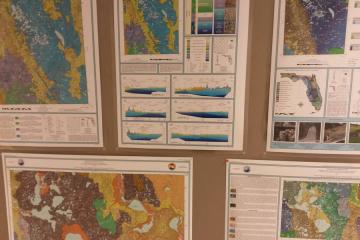
The FGS has grants under this program each year to study the near- surface
geology of various parts of the State.
The U.S. Environmental Protection Agency in their “Ground Water Resource
Assessment Technical Assistance Document” specifically states that State
Geological Surveys should be the primary agencies for the state ground water
regulatory agencies to work with in characterizing the aquifers of the state. In
this statement, the EPA has recognized the separate, valuable mission and
services carried out by state geological surveys.
The National Academy of Sciences, through a report released by their National
Research Council, also recommends the state geological surveys be the primary
state programs to be relied on for information related to: geochemistry,
biogeochemistry, fluids in and on the earth, sustaining sufficient natural
resources, mitigating geological hazards, and minimizing and adjusting to the
effects of global and environmental change.
FGS Staff Productivity / Involvement
Geologic project or report production has increased ten-fold over the last
fifteen years while staff numbers have been relatively unchanged. This is due to
a revised and redirected mission designed to provide applied geologic products
with short turn-around time to supply the public and agencies with scientific
support to assist with planning and environmental conservation / protection
decisions.
The number of interagency assistance contracts and grants has increased from
only one twenty five years ago, to more than an average of twelve per year in
recent years. These include partnership projects with several federal agencies,
state agencies (including several bureaus within the DEP), all water management
districts, counties, cities, and universities. These have averaged in total
about $200,000 per year in supplemental budget for the FGS.
The “Geological Research Programs” of the Florida Geological Survey have
received Davis Productivity Awards, for their increase in applied research
productivity serving the Florida public.
The Director of the Survey is Treasurer of the Association of American State
Geologists (AASG) and continues as an active member. This is an association of
the Chief Executives of the fifty state geological surveys. This national
visibility and recognition reflects the respect the other 49 State Geological
Surveys have for the Florida program. In addition, it has resulted in a dozen or
more federal grants to the FGS for geologic projects (ultimately returning
federal tax dollars to Florida which previously went to other states).
Other professional staff have been elected President of the
Southeastern Geological Society, the Florida Association of Professional
Geologists, and the Florida Section of AIPG.
Several staff have been singled out by external groups for their outstanding
contributions and production. These have included DNR Employee of the Month
selections, DNR Sustained Exemplary Performance Awards, Individual Davis
Productivity Awards, DEP Total Quality Leadership trainers, DEP Ecosystem
management committee members, DEP Employee of the Month, many technical advisory
committees members, Legislative committee appointments, and university advisory
panels. In addition, several professional staff had been asked to serve on the
Florida Board of Professional Geologists Examination Committee (which prepared
the professional geologist exam for Florida PG’s).
Due to General Revenue reductions and trust fund shortfalls over the last decade
the FGS has lost several staff positions. As a result all staff have taken on
several jobs, learned additional skills, and worked many extra hours to continue
to provide the professional product we expect. These are really Public Service
Heros as described by the Davis Productivity Awards Chairman.
Lectures are routinely given to schools and civic groups on Florida Geology and
rocks and minerals, and educational publications have become a continuing part
of our publication series (including a new poster series, State Park Leaflets,
and maps and Special Publications describing the State’s geologic resources and
history). In typical years in response to requests, the FGS sends out an average
of 1,000 publications per month to the professional community and the public.
More recently our publications are available on our website, providing
continuing access for the public.