|
•
Offshore Sand Resources Identified along East Coast
More…
|
•
Atlas of Florida's Beach Sediments Completed
More…
| |
•
Survey Gizmo Provides FGS with Valuable Customer Feedback
More…
| |
•
STATEMAP Program Receives Record Funding in its 19th Year
More…
| |
•
Innovative Tool Developed by FGS to Improve Mapping Productivity
More…
|
•
Planning the Future of Geologic Mapping in Florida
More…
| |
•
STATEMAP: Inverness Region Completed
More…
| |
•
Deep Coring Project Completed in Broward County
More…
| |
•
A Mile of Core in Southwest Florida Described
More…
|
Dear Colleagues:
We are excited to announce that the Florida Geological Survey (FGS) will move to
Regulatory Programs. Our FGS folks will be a great addition to the
Regulatory Programs team as they will be supplying critical scientific support,
research and assessments to the various regulatory districts and divisions in a
more efficient and consistent fashion.

The FGS is full of talented and committed folks who
work hard every day to support the FGS' mission to
collect, interpret and provide quality geologic
information about Florida. Jon Arthur will
continue to serve as the FGS Director, and will
report to Jeff Littlejohn, Deputy Secretary for
Regulatory Programs.
Jeff is excited to welcome Jon and the rest of
the FGS to his team, and to better utilize important
work they do to protect and conserve Florida's
important natural resources. We are confident
that this move will benefit the FGS and Florida's
environment by helping DEP become a more effective
and efficient agency. Thanks for helping us
make this transition a smooth one.
Sincerely,
Herschel T. Vinyard Jr.
DEP Secretary
Bird Sink Dye Trace Study
|
MEDIA ADVISORY: Feb. 29, 2012
DEP’S FLORIDA GEOLOGICAL SURVEY CONDUCTS NORTH FLORIDA WATERS DYE STUDY
~Test needed to confirm groundwater flow patterns~
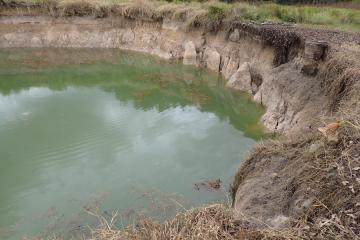
Trees provide shade to Bird Sink.
TALLAHASSEE – The Florida Department of Environmental Protection’s (DEP) Florida Geological Survey (FGS) is conducting a dye study in Wakulla and Spring Creek to investigate possible sources of nutrients in the spring systems as part of a long-term groundwater flow study in the region.
The FGS injected the dye, called uranine, in Bird Sink on Feb. 22, 2012. This is a sinking stream or “swallet” located in Leon County at I-10 and State Road 59, near the town of Lloyd. The dye will be transported with currents on an outgoing tide and will be tracked throughout the springs system by FGS staff.
The objective of the dye study is to assess hydrologic conditions within Wakulla and Spring Creek system. The movement of dyed water will provide scientists and resource managers with information on how water flows within the springs system.
The injected dye is a harmless, Environmental Protection Agency (EPA) approved organic solution similar to food coloring agents used in cooking. The dye will eventually degrade by natural processes. It is possible that some of the dye, which is bright green, may appear in surface water features like springs, river runs, sinkholes and in rare occasions, private wells. Local governments have been advised about the dye study.
The dye poses no risk to human health or the environment.
|
|
Contact person/info:
Dr. Rodney DeHan
Nitrogen Sourcing Pilot Project Completed
Springs in the Suwannee River basin are among the most contaminated of Florida’s
springs with regard to nitrate.
Water discharging from some of the basin’s springs has nitrate concentrations in
excess of the 10 mg/L drinking water standard. In an attempt to restore water quality in these springs, the Department
of Environmental Protection is developing
Basin Management Action Plansfor the nitrate sources within the
basin.

To have a better understanding of the sources of
nitrate in two springs, a pilot project at Convict and Royal Springs has been
completed. Funded by the Springs Initiative the Florida
Geological Survey’s Applied Geoscience Services Section and the Division of Environmental
Assessment and Restoration’s Groundwater Section worked together to delineate
spring basins and evaluate sources of the nitrate discharging from the Convict
and Royal Springs.
The area that provides the flow to
the two springs (i.e. springsheds) was estimated using a series of water-table
elevation maps.
The nitrate sources were identified by using water-quality and water-chemistry (isotopic) data.
Over 30% of the land in the springsheds is potentially fertilized for agricultural production. Based on available data,
3,887 dairy cows are maintained and 2,133,292 chickens are produced in these two springsheds. Estimates of the relative
nitrate loads from synthetic fertilizer and animal sources were determined in
the pilot study using isotopes. Intermittent flow has been
occurring in both Convict and Royal Springs and both ceased to flow during the
project. Nitrate concentrations in Convict Spring exceeded the drinking water standard of 10 mg/L
.
Contact person/info:
Tom Greenhalgh, P.G.
Click here for a copy of the Convict
and Royal Springs report.
| |
|

Doug Calman, the FGS Employee of the
Year in 2011, was awarded DEP
Employee of the Month for November.
Doug rejoined DEP’s Florida
Geological Survey (DEP/FGS) as
Research Librarian in August 2006
after a 26-year hiatus.
He previously held the
position from September 1977 to
November 1980.
DEP/FGS is extremely
fortunate to have this dedicated
employee back on board as his work
is invaluable to all geological
research projects at the FGS.
His services are also
available to geoscientists
throughout DEP and to the public.
As an integral part of the
initial phase in most research
proposals or projects, Doug conducts
a literature review of published
research, including difficult to
find “gray” literature.
Doug maintains several
reference-databases of importance to
specific projects or of special
significance to the various
responsibility areas of FGS research
scientists, an example being a
reference database on arsenic in
groundwater.
He
continuously adds to the FGS
publications and geological
information available to the public
via the internet including
improvements to the quality,
resolution, and ease of use of this
digital material.
In addition to his Research
Librarian duties, Doug works closely
with the Leon County Schools
Advocacy and Resource Center
overseeing students who are scanning
hard-copy geological sample
descriptions; these documents
include irreplaceable
and valuable geologic data
dating back to the early 20th
century.
His willingness to work with
challenged students and their
teachers gives the students an
opportunity to contribute and learn
while also making this DEP/FGS data
available to the public.
Doug’s dedication to excellence and
service is an inspiring example to
others; he is well deserving of
recognition as the DEP November 2011
Employee of the Month.
|
On January 28th,
2012 the Florida
Geological Survey
(FGS) led a field
trip to Alum Bluff
for students from
the University of
South Florida (USF)
who are taking a
course in
paleoecology.
This has been an
annual event for
over a decade.
Peter Harries, a
Dean and professor
in geology at USF,
has been bringing
his students to this
classic locality,
with the help of the
FGS, to give the
students a hands-on
project related to
environments that
prevailed in Florida
millions of years
ago. This year
over 20 students
participated in the
trip even though the
conditions at the
bluff were less than
perfect. Heavy
rains in the upper
basin created high
water levels in the
Apalachicola River
obscuring one of the
geologic units of
interest.
At Alum Bluff the
students practice
fundamental geologic
activities like
outcrop description
and measurement,
fossil content, and
sediment sampling.
This locality is
widely noted among
geologists as being
the tallest natural
exposure of geology
in Florida and
perhaps is one of
the most studied
geologic exposures
in the Southeast.
Over 100 feet of
sediment is exposed
at Alum Bluff. The
strata exposed there
range from about 18
million years to
several hundred
thousand years in
age. Of
particular interest
to paleontologists
are the diverse molluscan faunas
that occur in two of
the four exposed
geologic units at
Alum Bluff.
|
|
Investigation of Offshore Area Along
Florida’s Northeast and Central East Coast
The
Bureau
of
Ocean
Energy
Management
(BOEM),
formerly
known
as
the
U.S.
Minerals
Management
Service
(MMS),
and
the
Florida
Geological
Survey’s
Geological
Investigations
Section
have
a
history
of
cooperative
investigations
of
Florida’s
offshore
marine
sediment
resources.
The
current
cooperative
agreement
is
an
ongoing
multi-year
study
to
identify
potential
sand
resources
for
beach
replenishment
off
Florida’s
northeast
and
central
eastern
shore.
To
date,
over
3,000
miles
of
seismic
data,
numerous
vibracores,
as
well
as
seabed
and
beach
samples
have
been
collected,
processed
and
analyzed.
The
results
of
the
tasks
completed
in
these
investigations
are
detailed
in a
series
of
annual
reports
to
the
BOEM.
These
reports
are
available
on
disk.
This
year’s investigation involved:
· the
collection,
processing and
analysis of
approximately 387
miles of seismic
data collected in
federal waters
extending from three
to approximately ten
miles
offshore of Volusia
and northern Brevard
Counties,
· the
collection of 18
seabed samples and
the analysis of a
total of 21 seabed
samples collected
from offshore of
Volusia County,
· the
analysis of 120 vibracores from
offshore Volusia
County,
· the
processing of 28
samples collected
from northern
Brevard County
beaches and
· the
analysis of samples
collected at
approximately one
mile interval from
both the beaches of
Volusia and northern
Brevard Counties.
The
recent
investigation,
completed
in
September,
2011,
culminated
in
the
analysis
of
the
shoals
in
federal
waters
offshore
of
Volusia
County
and
a
compilation
of
estimations
of
reserves
of
beach
restoration-quality
sand
contained
in
them.
|
|
Nearly 2,000 Samples Analyzed to Produce
Atlas of Florida Beach Sediments
Back
to top
Sandy beaches are
one of Florida’s premier tourist
attractions. Because their preservation is vital, problems
like beach erosion are a concern. Unfortunately, commercial and residential
development along beaches limits
protection options in many parts of
the state.
The periodic placement of sand along eroding sections of beaches
is the preferred method for shoreline protection. Sand added to the beach during this
replenishment process should match, in grain size, color, and
type, the sand already on the beach. Therefore, a basic understanding of present
sand conditions is essential to proper sand matching in
connection with beach preservation and replenishment efforts.
To enhance our knowledge of
Florida’s beaches, the Geological Investigations
Section of the Florida Department of Environmental
Protection’s Office of the Florida Geological Survey
received funding from the National Oceanographic and
Atmospheric Administration (NOAA). The funding was used to create an atlas of
beach sediment characteristics for Florida. Sampling locations at intervals of
approximately one-mile were established for all
Florida beaches along the Atlantic Ocean and Gulf of
Mexico.
Final reports have been submitted
to NOAA regarding the completed sampling of beaches
in peninsular Florida, the Keys, the Florida
Panhandle and the Big Bend. The reports provide
descriptions, photographs and granulometric (grain
size) analysis of beach sediments at each location
at the time of sampling. Additionally, determination of the samples’
sediment color is included in the reports. While color is considered a less important
character , the political and economic consequences
of mismatching beach sand color can be considerable.
Inlets at the mouths of rivers, bays and harbors
along Florida’s coast affect the flow patterns of sediments near
the shore. These sediments are made up of carbonate and
non-carbonate grains. Carbonate grains typically consist of shell
fragments while non-carbonate grains are predominantly quartz.
Significant changes in the percentage of
carbonate material along the beaches of peninsular Florida have
been identified. Additionally, the study has revealed
variations in grain size. Here, a direct correlation was found between
carbonate percentage and grain size: where carbonate percentage
increases, so does grain size. The carbonate sediments present in the
samples were coarser than the non-carbonate sediments.
The general trend, from north to south along the
east coast of Florida, shows a steady increase in the percentage of carbonate
material toward Government Cut, north of Key Biscayne, in Miami-Dade County. South of Government Cut, there is a substantial and abrupt decline in
carbonate material across Key Biscayne to the end of the beaches in the upper
Keys.
In contrast,
the beach sand samples collected from the middle and
lower Keys in Monroe County were almost exclusively
carbonate. The beaches on Little Crawl Key, Munson
Island and Key West, however, show carbonate
percentages that are significantly lower. These beaches appear to have undergone
replenishment activities in which non-native
sediments were introduced. Mean grain size is largest in the Spanish
Harbor Keys at the geographic boundary between the
lower middle and lower Keys.
The percentage of carbonate
material on the southwest coast of Florida varies
substantially. The general trend from south to north shows a
decrease in the percentage of carbonate material
northward. Carbonate percentages broadly peak at the
Lee County/Collier County line, in central Lee
County and in central Sarasota County.
The beach sand samples collected
from the northwest coast of Florida were almost
exclusively non-carbonate. The trend from west to east along the
northwest coast of Florida shows a general eastward
decline in mean grain size to Cape St. George. From Cape St. George eastward, there is an
increase in mean grain size to the beginning of the
Big Bend region north of Ochlockonee Bay on the
Franklin-Wakulla County line. The mean grain size is
greatest on Perdido Key, in western Escambia County,
on Santa Rosa Island, in eastern Escambia County,
and on the mainland beaches of western Bay County.
The
beaches of Florida’s Big Bend are highly
discontinuous. Two regions of beaches, in a more or less
natural state, were identified. These are comprised of the beaches of Wakulla
County and the beaches in Levy and Dixie Counties. In contrast, the remaining beaches in the Big
Bend, lying in Taylor, Dixie, Citrus, Hernando and
mainland Pasco Counties, are geographically limited,
narrow and probably, at least partially, manmade.
Knowledge
of sediment characteristics, conditions, and trends
along Florida beaches is essential to the
sand-matching component of periodic sand
replacement, the preferred method for protection and
restoration of Florida’s shoreline. This in-depth study, made possible by NOAA
funding, provides this knowledge.
Contact
person/info:
Daniel C. Phelps, P.G.
or
Dr. Christopher Williams, P.G.
|
|
|
|
The FGS web site survey contains five
questions:
1. On a
scale of 1 to 5 with 1 being poor and 5 being excellent, did you
find the FGS website easy to navigate?
2. Did
you find what you were looking for? (Yes/No).
3. If
not, what were you trying to find? (space provided for typed
response).
4. If you
would like a professional geologist to contact you about your
question, please provide your name and phone number or email
address in the space below (space provided)
5.
What can we do to improve the web site to serve you better?
(space provided).
The responses
to
questions
number
1
and
2
are,
by
necessity,
evaluated
in
light
of
any
comments
offered
verbally
in
questions
3, 4
and
5. A
large
percentage
of
visitors
start
answering
the
survey,
but
do
not
go
beyond
these
two
questions.
Responses
to
question
3
are
used,
when
appropriate,
to
improve
web
site
content
or
navigation
links.
Web
visitors
who
provide
contact
information
in
Question
4
are
contacted
by
phone
or
email.
If
the
comment
concerns
web-related
issues,
the
FGS
web
administrator
replies
and
provides
additional
information
as
requested.
If
the
question
concerns
publications,
the
FGS
librarian
is
asked
to
respond.
Other
geology
or
hydrogeology
questions
are
directed
to
the
appropriate
FGS
staff
specialists
for
response.
The
responses
to
question
5
are
another
opportunity
to
improve
the
usability
of
the
FGS
web
site.
Visitors
may
either
have
ideas
on a
better
way
to
present
our
information,
or
have
suggestions
on
additional
material
to
include.
All
comments
are
taken
seriously
and
applied
when
appropriate,
feasible,
and
according
to
the
FDEP
Web
Standards.
Contact
person/info:
Frank
Rupert, P.G.
|
|
STATEMAP
Program Completes Mapping in Inverness Area
The
FGS
STATEMAP program completed
geologic mapping of the eastern portion of the USGS 30’ x 60’ Inverness
quadrangle in August, 2011. This mapping, which was funded in part by the
STATEMAP component of the National Cooperative
Geologic Mapping Program(NCGMP), was the result of
an award by the USGS for$105,643. This represented
the seventeenth straight year that the FGS received funding from the NCGMP for
new geologic mapping in Florida.
Field
mapping crews from the STATEMAP program spent
several weeks in the area gathering new geologic
data for the map. Additionally, the
FGS Geological Data Acquisition
Program drilled
several hundred feet of new cores for the project.
Each of several hundred wells and surface samples
housed at the
FGS Sample Repository
were examined by staff geologists for geologic
contact data and compiled along with field data and
the new core data to generate the geologic map. The
project produced a new geologic map, a geomorphology
map, geologic cross sections (Open-File Map Series
102), and explanatory text (Open-File Report 96).
These reports are currently in final review
and will be available via the
FGS Library
in April, 2012.
Contact
person/info:
Rick Green, P.G.
|
|
STATEMAP Program Receives Record
Funding Amount

The FGS
STATEMAP program
recently received a record $197,871 from the US
Geological Survey for geologic mapping. Two areas
for mapping are funded for 2011-2012:
the Tarpon
Springs quadrangle, and the western portion of the
Inverness quadrangle.
The awarded funds, which represent an 87% increase
over 2010-2011 funding, will be used for new
geologic mapping of the USGS 30’ x 60 Inverness and
Tarpon Springs quadrangles. This mapping, which was
funded in part by the
STATEMAP
component of the National Cooperative Geologic
Mapping Program
(NCGMP),
represents the eighteenth consecutive year that the
FGS has received
funding
from the NCGMP.
The Tarpon
Springs quadrangle was selected for
detailed geologic mapping in part
due to the 2010 “frost freeze”
sinkhole events
related to the Dover/Plant city
area. This area is prone to
sinkholes and a better understanding
of the relationship between geology
and groundwater is critical toward
minimizing geologic hazards and
enhancing water resource
sustainability. The mapping project
will be a cooperative effort between
FGS staff and two private-sector
consulting firms(SDII-Global
andHSA Engineers
and Scientists).
Each of these companies has agreed
to provide matching funds in the
form of geologic data and staff time
for use in generating the geologic
map. The addition of these private
sector contributions was
instrumental in leveraging an
additional $27,500 worth of grant
from the USGS STATEMAP Program.
The western
portion of the Inverness quadrangle
was also selected for geologic
mapping during 2012-2012. The
eastern portion of the
Inverness
quadrangle was mapped by the
STATEMAP program in 2010-2011 (see
additional article for more
details). Geologic mapping for both
projects will be completed in August
of 2012 and will result in several
new Open-File Map Series and Open
File Reports. The maps and reports
will be available through the
FGS library
in late 2012.
Contact
person/info:
Rick Green, P.G.
STATEMAP Program Develops a New Mobile GIS Platform
for Geologic Mapping
The
FGS
STATEMAP program
recently developed an innovative and inexpensive
mobile GIS platform for geologic mapping. The
system, which was primarily developed utilizing
surplus and existing equipment, allows staff
geologists to map from a moving vehicle more
efficiently.
Prior to using this new method, staff geologists
kept notes and recorded observations on a paper copy
of a 1:24,000 scale quadrangle and then transcribed
the data once they were back in the office. This
required that the quadrangle be scanned,
georeferenced in GIS, and then that the notes each
be manually transcribed into the GIS project. This
was a very time-consuming and inefficient process.
Capturing data
directly on a laptop in a GIS
environment greatly increased
accuracy by registering field points
directly to a
detailed
digital map with standardized
notations and symbology. This new
system resulted in a five-fold
increase in the amount of
observations which were made by
field geologists over the prior
year’s project (using paper-based
methods). In addition to the
increase amount of data gathered,
numerous days worth of office staff
time were saved by capturing the
data directly in the GIS environment
and avoiding the need for
labor-intensive transcription of
data.
The system was
assembled primarily from existing
and surplus resources and only
required the purchase of minimal
(<$100) additional equipment. The
system, which is customized
specifically for STATEMAP projects
but can be adapted for other
purposes, utilizes a vehicle-mounted
laptop, GPS, ArcPad 10, and a
special keyboard.
This software and keyboard have been
programmed with macro commands that
allow field geologists to capture
observations directly in a GIS
environment. Up to 36 custom macros
can be programmed into this keyboard
and executed with a single
keystroke, saving significant time
for each observation. For example, a
geologist is now able to record the
presence of exposures with one click
of the mouse. If they desire
additional notes for the data point,
it simply requires a “double-click”
on the data point with a mouse and a
form (shown above) opens for
additional fields to be populated.
The software
also allows rapid
switching between
GIS coverages
(aerials, property
records, scanned
historical
quadrangles, etc)
with a single
keystroke. In
addition to geologic
data, the program
captures streaming
data from the GPS
(tracklogs) and
allows geologists to
rapidly analyze
records of travel
for the end of the
day. One use of
these tracklogs is
to plot the course
of the vehicle as
“speed over ground”
which allows the
geologists to assess
whether or not an
area needs to be
covered more slowly
or might need a
second look.
If you are
interested in more
details, a poster
was presented at the
Geological Society
of America annual
meeting in
Minneapolis. The
text for the
abstract can be
accessed here.
Contact person/info:
Rick Green, P.G.
|
|
Florida State Mapping
Advisory Committee (SMAC) Meeting Held

The Florida State Mapping Advisory Committee (SMAC)
met with the Florida Geological Survey (FGS) on
October 7, 2011 to assess the current mapping
projects and plans for future efforts. The meeting
was held at the Florida Museum of Natural History in
Gainesville, Florida. This committee meets annually
in order to determine geological mapping priorities
for the FGS
STATEMAP program
. Each year, the SMAC revises the
long-range
geologic mapping plan
and decides which area(s) that the STATEMAP program
will propose to the US Geological Survey for the
following year’s mapping projects. Criteria for
mapping prioritization include areas that: 1) are at
highest risk for impacts to water supply, 2) have
high probability of population increase or
development, 3) have special geologic conditions
(such as karst, mineral resources, or natural
resources such as springs), and 4) where other State
and Federal projects require more detailed geologic
mapping to provide data for ongoing or planned
studies.
This year, a
recommendation was made by SMAC
members to propose the Daytona Beach
30’ x 60’ quadrangle for mapping in
2012-2013 because it meets all of
the criteria listed above and the
St. Johns River Water Management
District is planning projects that
could compliment the efforts of
STATEMAP such as geophysical logging
and drilling projects. Mapping of
the selected areas also benefit
several ongoing or planned projects.
The SMAC also agreed to propose
mapping of the Cedar Keys quadrangle
in 2012-2013. The SMAC recognized
that it is important to begin
combining the prior STATEMAP
deliverable maps into a standardized
digital compilation for ease of use
in GIS. As such, they recommended
that the FGS compile older (AutoCAD)
STATEMAP projects into a
standardized GIS format.
As
in past meetings several of the
attendees participated in a field
trip to see examples of typical
features that have been mapped. This
not only provides opportunities to
gain insight into specific geologic
features but provides an opportunity
for informal exchange between
participants about the STATEMAP
projects, ideas for project
improvements, and an opportunity to
consult with the many experts that
are present. SMAC member Roger
Portell from the Florida State
Museum of Natural History led this
year’s trip to a quarry near High
Springs, Florida where participants
could see the Bumpnose Formation,
Ocala Limestone, and numerous karst
features.
Contact
person/info:
Rick Green, P.G.
Deep Coring Project Complete in
Broward County with USGS Partners

Coring and
monitor well construction for the
Broward County Aquifer Storage and
Recovery project was completed
November 30th,
2011. This cooperative project
between FGS, the USGS and Broward
County has resulted in a 1300’
monitoring well bored into the upper
Floridan Aquifer and is currently
meeting all SFWMD requirements.
FGS set up a 4” PVC liner to a depth
of 680-700’ to ensure future
sampling access through a
potentially unstable portion of the
Hawthorn Group.
This core and
well have already provided valuable
insight into the geologic framework,
water quality and aquifer
characteristics of northeastern
Broward County. FGS and USGS
are preparing rock chemistry data
and lithologic logs to help assess
water-rock reactions that may affect
water quality and flow.
Future use of the well
will include water quality sampling,
flow testing and likely additional
borehole characterization.
This
cooperative project between the FGS,
USGS and Broward County was designed
to investigate the feasibility of
aquifer storage and recovery in
north-eastern Broward County.
During
the project, it was modified to
extend the coring depth from 1200’
to 1300’ based on the geologic
information provided by the 1200’
core.
FGS
responsibility in this project was
to drill the test hole, collect
continuous core samples, construct
the monitor well and conduct the
geochemical analysis.
Geochemical analysis to be completed
by April 30th,
2012, will consist of whole rock
analyses of 15 samples,
SEM/Microprobe analyses on 15
polished thin-sections, analysis and
interpretation of the data, and
report of the results.
Contact person/info:
David Paul, P.G.
or
Ken Campbell, P.G.
Describing More Than a Mile of Core
in Southwest Florida

Since 2005, the Florida Geological Survey (FGS)
has been continuously contracted by the Southwest
Florida Water Management District (SWFWMD) to
provide detailed lithologic descriptions of well
samples provided by the SWFWMD’s Regional
Observation and Monitor-well Program (ROMP).
ROMP installs and monitors a network of wells
throughout the 16 county District, retrieving
lithologic samples from those holes. From the
lithologic samples, hydraulic properties are
disseminated for the various aquifers and confining
units penetrated by the wells. The crucial data
gleaned from the detailed lithologic descriptions is
used by the District to manage its vital water
resources. The terms of contract require the FGS to
provide up to 6,500 feet of detailed lithologic core
sample descriptions and all wells are to be
permanently archived in the State’s geologic well
sample repository. As part of that contractual
agreement, SWFWMD provides funding to help maintain
and operate the State’s geologic well sample
repository.
Contact person/info:
Clint Kromhout, P.G.
Additional Links:
SWFWMD:
Regional Observation Monitor-well Program (ROMP)
FGS:
State Geologic Well Sample Repository
|
|
|
|
|
|
|
|
| | |