
|
Deborah Shelley -
Deborah.Shelley@dep.state.fl.us
8300 West State Road 46
Sanford, Florida 32771
Phone #: (407) 330-6727
Office hours: 8:00am-5:00pm (field staff availability varies)
The Tomoka Marsh Aquatic Preserve is an estuarine system comprised of six
distinct areas which include portions of the Halifax River, Smith Creek,
Bulow Creek, the Tomoka River, the Tomoka Basin and an 1,100 acre mosquito
impoundment area. The endangered West Indian manatee is a summer resident
of the area, traveling in the Halifax and Tomoka Rivers.
Approximately seven miles of the Halifax River, north from the southern
boundary of Ormond by the Sea is designated aquatic preserve. The Halifax
is a long, wide, shallow estuarine lagoon bounded on the west by the Florida
mainland and on the east by a barrier island. The mixing of salt water from
the Atlantic Ocean introduced through the Matanzas inlet to the north and
the Ponce DeLeon Inlet to the south, with fresh water from the Tomoka River,
Bulow Creek, and the upper Halifax River drainage basin creates the estuary.
The Atlantic Intracoastal Waterway (ICW) channel is part of the Halifax River.
The ICW is 125 feet wide and had been dredged to a depth of 12 feet.
Smith Creek is a shallow, estuarine creek with numerous oyster beds. Portions
of the natural channel of the creek were dredged to accommodate the ICW. The
remaining natural channel is primarily salt marsh, interspersed with small
islands, both natural and created.
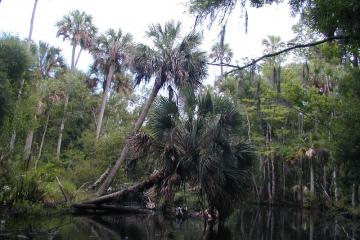
Bulow Creek is a shallow meandering waterway bordered by marsh and floodplain
hardwood trees. From its origin in vast wetlands to the north, the creek flows
south for about 4 miles meandering to its confluence with the Halifax River.
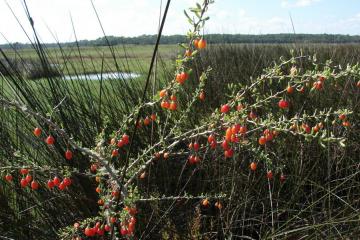
Large expanses of black needle rush (Juncus roemerianus) border the
creek.
The Tomoka River watershed drains an area of about 150 square miles, making it
one of the largest sub-basins within the Florida East Coast Basin. Man-made
drainage in the form of numerous canals has increased the boundary of the
Tomoka watershed. The natural headwaters of the Tomoka River originate in
low-lying areas south of Interstate 4 (I-4) and west of Interstate 95 (I-95).
From its natural headwaters, the river flows generally north-northeast until
its confluence with the Halifax River at the Tomoka Basin. The Tomoka River
east of U.S. 1 is designated aquatic preserve.
The Tomoka Basin is approximately 400 acres of shallow estuarine bay, located
at the confluence of the Tomoka and Halifax Rivers.
The 1100-Acre Mosquito Impoundment consists mainly of tidal marshes
interspersed with open water with perimeter and some interior ditches. The
impoundment has not been actively managed since 1980 and is permanently opened
to the Halifax River and other areas by large culverts and two breaches in the
impoundment dike walls. Although the marsh inside the impoundment is disturbed,
the culverts and breaches provide access for many species of fish. The area is
utilized by fisherman and for commercial crabbing. Numerous wading birds
including wood stork, roseate spoonbill, snowy egret, great egret, great blue
heron, and white ibis are often observed feeding in the area. Shorebirds such
as black-bellied plover, spotted sandpiper, least tern, royal tern, and several
species of gull also utilize the area.
October 21, 1969
The preserve is located along the east coast in southeastern Flagler County
and northeastern Volusia County near the cities of Ormond Beach and Flagler
Beach.
Approximately 8,000 acres of submerged lands and 10 acres of spoil islands
Tomoka Drainage Basin – approximately 150 square miles
Halifax River Drainage Basin – approximately 75 square miles
Estuarine habitats comprised of
tidal marshes dominated by black needle rush (Juncus roemerianus)
or smooth cordgrass (Spartina alterniflora); unconsolidated substrates
with mud, sand, shell or oyster beds; algal beds; and blackwater streams.
The Tomoka Marsh Aquatic preserve is a valuable nursery area for fishes,
shrimp, and crabs caught commercially and recreationally in the Atlantic
Ocean. Other species not directly important to commercial fishing but
necessary to the food chain also depend on the estuary and the diversity
of habitats within.
The preserve is utilized by over 50 species of fish, including snook and
redfish, as well as manatees, marine turtles, bottlenose dolphin, wood
storks, numerous wading birds and a variety of other wildlife.
The Halifax River and Smith Creek are an important travel corridor for the
endangered West Indian manatee. The Tomoka River and its downstream
tributaries are especially significant to the slow-moving manatees as quiet
places to eat, rest, drink fresh water, mate and give birth. The Tomoka River
system was the site of the first documented manatee birth in the wild. The
Tomoka River and its tributaries Strickland, Thomson and Dodson Creek are
designated as a Manatee Sanctuary and are used by manatee during the summer
months. Other listed species that utilize the aquatic preserve include wood
stork, bald eagle, snowy egret, Atlantic salt marsh snake, and common snook.
Rare / Endangered Species
Common
Name |
Scientific
Name |
State |
Federal |
| |
|
|
|
Fishes |
|
|
|
| common
snook |
Centropomus
undecimalis |
n/a |
n/a |
| |
|
|
|
Reptiles |
|
|
|
| American
alligator |
Alligator
mississipiensis |
SSC |
T (s/a) |
| Eastern
indigo snake |
Drymarchon
corais couperi |
T |
T |
| gopher
tortoise |
Gopherus
polyphemus |
SSC |
n/a |
| Atlantic
salt marsh snake |
Nerodia
fasciata taeniata |
T |
T |
| Florida
pine snake |
Pituophis
melanoleucus mugitus |
SSC |
n/a |
| |
|
|
|
Birds |
|
|
|
| roseate
spoonbill |
Ajaia
ajaja |
SSC |
n/a |
| Florida
scrub jay |
Aphelocoma
coerulescens |
T |
n/a |
| little
blue heron |
Egretta
caerulea |
SSC |
n/a |
| snowy
egret |
Egretta
thula |
SSC |
n/a |
| tricolor
heron |
Egretta
tricolor |
SSC |
n/a |
| white
ibis |
Eudocimus
albus |
SSC |
n/a |
| Southeastern
American kestrel |
Falco
sparverius paulus |
T |
n/a |
| bald
eagle |
Haliaeetus
leucocephalus |
T |
E |
| brown
pelican |
Pelecanus
occidentalis |
SSC |
n/a |
| least
tern |
Sterna
antillarum |
T |
n/a |
| |
|
|
|
Mammals |
|
|
|
| West
Indian manatee |
Trichechus
manatus |
E |
E |
| |
|
|
|
Plants |
|
|
|
| giant
leather fern |
Acrostichum
danaeifolium |
C |
n/a |
| green-fly
orchid |
Epidendrum
conopseum |
C |
n/a |
| shell
mound prickly pear cactus |
Opuntia
stricta |
T |
n/a |
| Florida
coontie |
Zamia
floridana |
C |
n/a |
State listings are taken from the Florida Fish and Wildlife Conservation
Commission or as with plants Florida Department of Agriculture. Federal
listings are taken from the United States Fish and Wildlife Service. E=
Endangered; T= Threatened; T (s/a)= Threatened due to similarity in
appearance; SSC= Species of Special Concern; UR= Under review; n/a=
information not available or no designation listed
Smith Creek, Halifax River, Tomoka Basin, Bulow Creek, Tomoka River
Nineteen prehistoric sites have been identified near the preserve including
the remains of the Timucuan village, Nocoroco. The Nocoroco site had as many
as 200 palmetto-thatched huts, a common granary, and a council meeting house.
Nocoroco was situated at the tip of the peninsula that is now Tomoka State
Park, looking out into the Tomoka Basin.
The preserve supports a variety of uses including fishing, boating, canoeing,
crabbing, and wildlife observation. Commercial activities include canoe and
boat rentals, eco-tourism, guided fishing, and crabbing. A variety of
research activities have occurred in the preserve including water quality
monitoring, a 5-year juvenile fisheries assessment, salt marsh snake survey,
and radio telemetry manatee tracking.
Designations
The Tomoka River is designated as an Outstanding Florida Water and Manatee
Sanctuary.
Ownership / Manager
Title to all submerged lands and spoil islands within the preserve is vested
with the Trustees of the Internal Improvement Trust Fund, held in trust for
the people of Florida. Staff of the Office of Coastal and Aquatic Managed
Areas fulfills management responsibilities.
Major management / research / monitoring activities
Current projects include analyzing and publishing the results of the 5-year
juvenile fisheries survey; preparing and publishing the results of a two year
bird survey; preparing for an adult fisheries survey; and participating in the
restoration of a disturbed area of Bulow Creek.
Management Issues and Threats
Protection of manatee habitat and motor boat control; abatement of sand
deposition from upstream sources; cumulative impacts to water quality
associated with point and non-point sources of pollution; restoration of
disturbed areas; exotic plant control; environmental education; growth
management.
Management needs
Limited staffing and funding does not allow adequate time to address all
aspects of the many complex issues facing the Tomoka / Halifax system.
Immediate needs include additional staff and equipment for exotic plant
control, research, restoration of disturbed habitat, project review and
environmental education.
Department of Natural Resources. 1990. Tomoka Marsh Aquatic Preserve
Management Plan. Florida Department of Natural Resources, Tallahassee,
Florida
Florida Game and Fresh Water Fish Commission. 1997. Florida’s Endangered
Species, Threatened Species and Species of Special Concern, Official Lists.
Florida Game and Fresh Water Fish Commission, Tallahassee, Florida.
|