|
Florida Keys National Marine Sanctuary
33 East Quay Road
Key West, Florida 33040
(305) 292-0311
Monday through Friday 8am - 5pm
The delicate chain of islands, or "keys", extending
from the southern tip of Florida is internationally
regarded as a tropical paradise. This perception can
mainly be attributed not to the islands themselves, but
to the clear, shallow waters surrounding them. These
warm tropical waters are also known today as the Florida
Keys National Marine Sanctuary (FKNMS). The Florida Keys
and its marine environment offer unparalleled beauty and
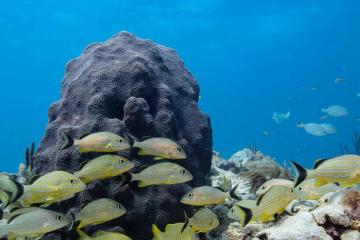
diversity. Teeming with thousands of colorful tropical
fish, marine invertebrates and plants, the waters of the
Florida Keys are home to the world's third largest
barrier coral reef system, thousands of acres of
seagrasses, and hundreds of miles of mangrove-fringed
shoreline. The waters surrounding the Florida Keys have
long been appreciated for their unique beauty and the
abundance of the marine life they support. That
world-renowned appreciation was echoed by Congress when,
in 1990, they designated these waters as a 2900
square-nautical-mile marine sanctuary.
The special beauty of the Florida Keys National Marine
Sanctuary brings with it some unique challenges for
protection. Every year, more than two and a half million
people come to the Keys to experience the wonders of the
waters. Year round, visitors and residents alike dive,
snorkel, fish, boat, and swim in these waters. A system of
mooring buoys, channel markers, and special marine zones is
in place to assure that the diverse and delicate ecosystem
of the Florida Keys National Marine Sanctuary remains
healthy for generations to come.
To protect the spectacular marine ecosystem of the
Florida Keys, the Florida Keys National Marine Sanctuary and
Protection Act was enacted by Congress and signed into law
by President Bush on November 16, 1990. The Act, first and
foremost, created the Florida Keys National Marine Sanctuary
boundaries, encompassing approximately 2900 square nautical
miles, with jurisdiction up to the mean high tide line. In
addition, the Act called for the National Oceanic and
Atmospheric Administration (NOAA) of the U.S. Department of
Commerce to prepare a comprehensive management plan for the
Sanctuary after consulting with the public and with federal,
state, and local government authorities. An Advisory Council
was established to act as conduit of public opinion and to
assist in the development of the plan. The FKNMS
Comprehensive Management Plan was developed and Sanctuary
regulations went into effect on July 1, 1997. The revised
Management Plan went into effect in December 2007. The
entire text of the Sanctuary regulations is printed in the
June 12, 1997 edition of the Federal Register. The
regulations for the more recently established Tortugas
Ecological Reserve are printed in the January 17, 2001
edition of the Federal register.
County:
Monroe
Nearby towns or cities: Florida Keys, Key West, Marathon, Key Largo
The FKNMS encompasses 3,801 square miles of
protected area consisting of the waters surrounding
the archipelago formed by the Florida Keys which
includes waters of Florida Bay, the Gulf of Mexico,
and the Atlantic Ocean.
The Florida Keys National Marine Sanctuary is at
the conflux of three watersheds. First, the
Mississippi River watershed drains 40% of the
continental United States. The Mississippi River
eventually drains down into the Gulf of Mexico where
those waters are then picked up by the Loop Current
which can be traced passing the Florida Keys as it
merges with the Florida Current (Gulf Stream).
Second, the Florida Bay and the Florida Keys are the
end recipients of the Kissimmee Okeechobee
Everglades (KOE) watershed which drains much of the
state of Florida. The third watershed affecting the
waters of the Keys originates in the Caribbean,
where the waters draining to the ocean are funneled
through the Yucatan straight and eventually merge
with the Florida Current (Gulf Stream).
Although the
best known feature of the Keys marine environment is its
coral
reefs, the shallow waters near the shore are actually composed of a
series of interconnecting and interdependent natural habitats.
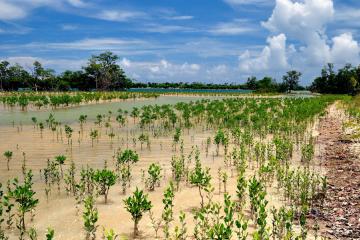
These include fringing mangroves and
seagrass meadows as well as
hardbottom regions, patch reefs and bank reefs.
When healthy, the communities of
mangroves, seagrasses and corals protect and enhance one another.
Upland, hardwood hammocks are equally important: they protect the
soil from erosion while their decaying vegetation provides
necessary nutrients to the mangrove and seagrass communities. In
turn, mangroves, seagrass beds and coral reefs serve as
self-repairing breakwaters to protect the hammocks--and the rest of
the Keys--by absorbing the force of the waves.
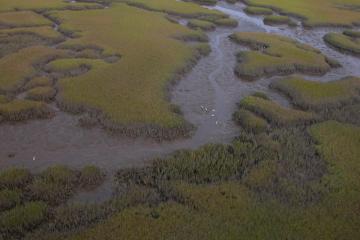
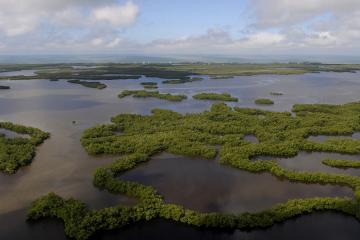
Fringing mangroves filter material
washed from the land, trapping debris and sediment. The remains of
plants and animals are broken down by bacteria and fungi, into
nutrients. Mangrove roots provide nursery grounds to to many
species of fish and invertebrates. Mangrove forests near North Key
Largo also are habitat for the endangered American crocodile.
Seagrass meadows grow in much of
Florida Bay and the shallow waters seaward out to the reef line.
They are a natural trap for sediments. The predominant turtle
grasses, which happen to be particularly vulnerable to pollution,
are nursery and feeding grounds for a host of attaching
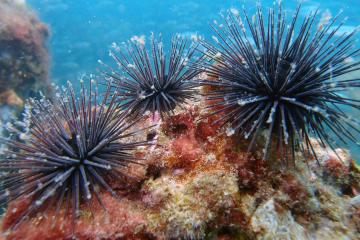
invertebrates and for the larvae and young of many organisms. These
include shrimp, spiny lobster, sea urchins, sponges, snapper, sea
trout, barracuda and grunts. Adult fish from the reefs often feed
among the seagrasses, and endangered species of green sea turtles
and manatees browse there regularly.
The Florida reef tract is the most
extensive living coral reef system in North American waters and the
third largest reef system in the world. It provides habitat,
refuge, and feeding grounds for countless colorful and exotic
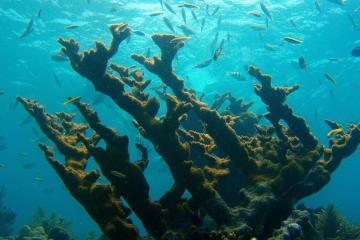
creatures. Colonies of tiny polyps from the complex structure of
coral reefs by secreting calcium carbonate. The waving forests of
sea whips and sea fans in the Keys are a uniquely Caribbean
feature, and are not found on reefs in the Pacific and Indian
Oceans.
The Florida
Keys National Marine Sanctuary contains one of North America's most
diverse assemblages of terrestrial, estuarine, and marine fauna and
flora. Formed by significant geological, physical, and biological
processes, the area is one of the most complex ecosystems on Earth,
and includes mangrove-fringed shorelines, mangrove islands,
seagrass meadows, hardbottom habitats, thousands of patch reefs,
and one of the world's largest coral reef tracts.
The Key's ecosystem supports a
diverse assemblage of species, including commercially and
recreationally important, unique to the area or spatially limited
due to habitat constraints.
Rare / Endangered
Species
Fully one third of Florida’s endangered species
call the coral reef ecosystem home for at least
part of their lifespan.
Further information on the endangered, rare and
threaten species of the Florida Keys National
Marine Sanctuary can be obtained from Volume II
of the Final Management Plan/Environmental
Impact Statement. This table does not include
Species of Special Concern and it does not
include plant species that are threatened or
endangered.
Common
Name |
Scientific
Name |
State |
Federal |
| |
|
|
|
Invertebrates |
|
|
|
| pillar
coral |
Dendrogyra
cylindrus |
E |
T |
| Schaus'
swallowtail butterfly |
Heraclides
aristodemus |
E |
n/a |
| Stock
Island tree snail |
Orthalicus
reses reses |
E |
E |
| |
|
|
|
Fish |
|
|
|
| Key
silverside |
Menidia
conchorum |
T |
n/a |
| |
|
|
|
Reptiles |
|
|
|
| American
alligator |
Alligator
mississippiensis |
SSC |
T
(s/a) |
| Atlantic
loggerhead |
Caretta
caretta caretta |
T |
T |
| Atlantic
green turtle |
Chelonia
mydas mydas |
E |
E |
| American
crocodile |
Crocodylus
acutus |
E |
E |
| leatherback
turtle |
Dermochelys
coriacea |
E |
E |
| Big
Pine Key ringneck snake |
Diadophis
punctatus |
T |
n/a |
| Eastern
indigo snake |
Drymarchon
corais couperi |
T |
T |
| Atlantic
hawksbill |
Eretmochelys
imbricata imbricata |
E |
E |
| Key mud
turtle |
Klinosternon
bauri bauri |
E |
n/a |
| Atlantic
ridley |
Lepidochelys
kempi |
E |
E |
| Florida
brown snake |
Storeia
dekayi victa |
E |
n/a |
| Miami
black-headed snake |
Tantilla
oolitica |
T |
n/a |
| Florida
ribbon snake |
Thamnophis
sauritas sackeni |
T |
n/a |
| |
|
|
|
Birds |
|
|
|
| Cape
Sable seaside sparrow |
Ammodramus
maritimus mirabilis |
E |
E |
| piping
plover |
Charadrius
melodus |
T |
T |
| white-crowned
pigeon |
Columba
leucocephala |
T |
n/a |
| Arctic
peregrine falcon |
Falco
peregrinus tundrius |
E |
T |
| Southeastern
American kestrel |
Falco
sparverius sparverius |
T |
n/a |
| Florida
sandhill crane |
Grus
canadensis pratensis |
T |
n/a |
| bald
eagle |
Haliaeetus
leucocephalus |
T |
T |
| wood
stork |
Mycteria
americana |
E |
E |
| least
tern |
Sterna
antillarum |
T |
n/a |
| roseate
tern |
Sterna
dougallii |
T |
T |
| Bachman's
warbler |
Vermivora
bachmani |
E |
E |
| |
|
|
|
Mammals |
|
|
|
| sei
whale |
Balaenoptera
borealis |
n/a |
E |
| blue
whale |
Balanoptera
musculus |
n/a |
E |
| fin
whale |
Balaenoptera
physalus |
n/a |
E |
| right
whale |
Eubalaena
glacialis |
n/a |
E |
| humpback
whale |
Megaptera
novaeangliae |
n/a |
E |
| Key
Largo wood rat |
Neotoma
floridana smallii |
E |
E |
| Key
deer |
Odocoileus
virginianus clavium |
E |
E |
| silver
rice rat |
Oryzomys
argentatus |
E |
E |
| Key
Largo cotton mouse |
Peromyscus
gossypinus allapaticola |
E |
E |
| sperm
whale |
Physeter
macrocephalus |
n/a |
E |
| Lower
Keys marsh rabbit |
Sylvilagus
palustris hefneri |
E |
E |
| Florida
manatee |
Trichechus
manatus |
E |
E |
State listings are taken from the
Florida Fish and Wildlife Conservation Commission. Federal
listings are taken from the United States Fish and Wildlife
Service. E= Endangered; T= Threatened; T (s/a)= Threatened due to
similarity in appearance; n/a= information not available or no designation
listed.
- Gulf of Mexico
- Tidal Passes and Nearshore Habitats
- Atlantic Ocean
Adjacent geomorphic features
include:
- Florida Bay
- Lower Everglades / South Peninsular Florida
The following reefs are protected
by marine zones established by the Florida Keys National Marine
Sanctuary:
Ecological Reserve:
Sanctuary Preservation Areas:
- Carysfort / South Carysfort
- The Elbow
- Dry Rocks
- Grecian Rocks
- French Reefs
- Molasses Reef
- Conch Reef
- Davis Reef
- Hen and Chickens
- Alligator Reef
- Coffins
- Patch
- Sombrero Key
- Newfound Harbor
- Looe Key
- Eastern Dry Rocks
- Rock Key
- Sand Key
Special Use Areas:
- Conch Reef
- Tennessee Reef
- Looe Key
- Eastern Sambo
The geological processes that formed the
reefs and the Florida Keys as we know them today
began in the Pleistocene Period. During this
era, melting glaciers following an ice age
raised sea level to where water covered much of
the Florida peninsula and all of the area that
is now the Keys. The warm temperatures and
shallow waters that covered this area were ideal
for coral growth. Scientists have found that the
Keys developed into a nearly continuous coral
reef tract from the area that is now Miami to
the Dry Tortugas. Core samples show massive hard
corals and point to a larger, denser coral reef
system than the living reef that now lies off
our shores. When the last ice age struck, about
28,000 years ago, sea levels dropped
drastically, and the Keys, as well as the
Florida Bay, were transformed into swamp, then
dry land. Then, about 11,000 years ago, water
levels moderated to about where they are now,
leaving the Keys exposed and filling Florida
Bay. From these ancient reef formations, two
types of substrate were formed: Miami Oolite,
and Key Largo Limestone. Both of these rock
types are the remnants of fossil coral
ecosystems, and both are extremely porous.
The Florida Keys National Marine Sanctuary’s
submerged cultural resources are unique,
non-renewable remnants of the Key’s colorful
maritime and submerged prehistoric past.
Submerged cultural resources are defined as
those "possessing historical, cultural,
archaeological, or paleontological
significance, including sites, structures,
districts, and objects significantly
associated with or representative of earlier
people, cultures, and human activities and
events" (15 CFR 922.2 (c)). The Sanctuary’s
submerged cultural resources encompass a
broad historical range from the European
Colonial Period to the Modern Era. Because
of the Keys’ strategic location on early
European shipping routes, the area’s
shipwrecks reflect the history of the entire
period of discovery and colonization. The
unique geological history of the Florida
Keys with its treacherous shallow and hidden
reef, set the stage for a colorful human
history. Shoals, sand flats, storms, and the
coral reef itself have stymied many
navigators through the centuries, and taken
their toll on many ships. Since the 1500's
over 800 documented shipwrecks have occurred
around the reefs and sand flats of the
Florida Keys. These vessels, which now rest
upon the ocean floor, carried a wide variety
of cargoes throughout the centuries, cargoes
that ranged from settlers, slaves, and
soldiers, to merchandise and treasure.
During the early twentieth century the
"wreckers" of the keys salvaged virtually
everything they could find, leaving behind
little original wrecks. These wrecks and the
stories that surround them give the Keys a
rich and exciting maritime culture. In
addition to the human aspect, these
shipwrecks, often referred to as "windows to
the past" also serve as artificial reefs,
providing an anchor and abode for the
brilliant and diverse life that inhabits
these waters.
More than three million visitors each year come
to the Keys by both air and auto. A great
majority of these tourists come to see or catch
fish and other marine wildlife, contributing up
to $1.2 billion to the economy of the Florida
Keys. These visitors directly support charter
boats for diving, snorkeling, sailing and
fishing, dive shops, bait and tackle shops,
marinas, restaurants, hotels, motels, and camp
grounds, and, indirectly, a multitude of
businesses from gas stations to barber shops.
Commercial fishing is the second largest industry in the
Keys. Some of the most important commercial species are
spiny lobster, stone crab, pink shrimp, mackerel, grouper
and snapper. Collectors of tropical fish and other marine
life also profit from the reef environment. The commercial
fleet supports about 1,200 families, which is close to 5
percent of the Monroe County's population. Stock Island
alone lands 7 million pounds with a dockside value of $24
million — that's 5 percent of Florida's total landings and
13 percent of total value.
In 2006, Monroe County was ranked the fifth most valuable
port in the nation, with a dockside value of about $54.4
million. This figure does not include retail sales and
profits made by wholesalers who marketed seafood products
worldwide. It's reasonable to predict that seafood and
related industries earned upwards of $70 million. This does
not take into account the millions of dollars of shrimp
caught off Key West and landed at other ports around the
Gulf of Mexico.
The Key Largo and Looe Key National
Marine Sanctuaries were established in
1975 and 1981 respectively and were
incorporated into the new Florida Keys
National Marine Sanctuary Management
plan.
The State of Florida and the federal government have been
working together for over 34 years to protect the marine
environment in the Florida Keys. This effective partnership
continues today in the Florida Keys National Marine
Sanctuary. Such a combined effort provides a comprehensive
ecosystem management approach for the long-term protection
of diverse natural resources in Keys waters. The National
Oceanic and Atmospheric Administration (NOAA), part of the
U.S. Department of Commerce, is the federal agency that
oversees the National Marine Sanctuary program. The Florida
Department of Environmental Protection (FDEP) is the state
partner involved in FKNMS management. Together these
agencies cooperate and consult with each other on how to
ensure the protection of FKNMS resources.
The Florida Keys National Marine Sanctuary and Protection
Act lays out certain rules for the FKNMS:
- Oil and gas development are prohibited; and
- Commercial vessel traffic is restricted within an
internationally designated "Area to be Avoided."
The Act also places particular emphasis on improving the
water quality throughout the area. The US Environmental
Protection Agency and the Governor of Florida, in
consultation with NOAA, were directed to prepare a water
quality protection program which were included in the
comprehensive management plan.
The 14 Action Plans within the FKNMS Management Plan
include: Science Management and Administration, Waterway
Management, Education/Outreach, Enforcement, Mooring Buoys,
Regulatory, Research and Monitoring, Maritime Heritage
Resources, Damage Assessment and Restoration, Water Quality,
Operations, Evaluation, Volunteer and Marine Zoning.
Revised Management Plan- December 2007
(http://floridakeys.noaa.gov/pdfs/2007_man_plan.pdf)
Strategy for Stewardship: Florida Keys
National Marine Sanctuary Final
Management Plan/Environmental Impact
Statement Volumes 1-3 (http://floridakeys.noaa.gov/management/welcome.html)
Florida Keys Eco-Discovery Center in Key West, FL-
http://floridakeys.noaa.gov/eco_discovery.html
Various posters, maps and brochures can be
obtained by contacting the Sanctuary office.
Please see the FKNMS website forand further information:
http://floridakeys.noaa.gov |