|
Pamela Sweeney
Biscayne Bay Environmental Center
1277 NE 79th Street CSWY
Miami, FL 33138-4206
(305) 795-3486
(305) 795-3470 FAX
Biscayne.Bay@dep.state.fl.us
Two Aquatic Preserves are named for Biscayne Bay. The first was founded in 1974 as the Biscayne Bay Aquatic
Preserve. Its boundaries include the inshore waters and natural waterways connected to Biscayne Bay from the
Oleta River in the north to the Card Sound Road bridge between the mainland and northern Key Largo, with
Biscayne National Park removed. This leaves two separate areas of state management; the northernmost area is
bounded by the headwaters of the Oleta River south to Cape Florida on the east, and just south of Chicken
Key and the Deering Estate on the west. The southernmost section begins just south of the Arsenicker Keys on
the west and Broad Creek on the east and ends south of Little Card Sound (at the Card Sound Road bridge).
The barrier islands of Miami Beach, Fisher Island, Virginia Key, and Key Biscayne form the eastern border of
the northern section. The residential developments along the mainland shore and the Miami central business
district form the western border. The construction of causeways and the Port of Miami and other dredged
islands have subdivided the northern preserve into eight basins. Dredge and fill projects have altered the
northern bay with channels too deep for seagrass growth. Despite the development that has taken place in the
northern bay there still are areas with abundant seagrass beds and mangrove fringe forests in certain areas.
State, county, and city parks provide a variety of access points and possible recreational activities within
Biscayne Bay. Swimming, kayak rentals, historic tours, and picnicking are a few of the activities that
visitors and residents can enjoy at
Oleta River State Park, the
Barnacle Historic State Park, and
Bill Baggs
Cape Florida State Park in the northern part of the Aquatic Preserve.
The southern part of the preserve consists of Card Sound
and Little Card Sound, located between the southeast
mainland of Florida and the northern end of Key Largo, in
Miami-Dade and Monroe counties. This portion of Biscayne Bay
Aquatic Preserve is part of a larger area of protected
marine environments and is included within the Florida Keys
National Marine Sanctuary boundaries. Biscayne National Park
is located to the north. Protected areas include mangrove
creeks and islands of mangroves and hammocks managed by the
Crocodile Lakes National Wildlife Refuge,
John
Pennekamp Coral Reef State Park, and the
Dagny Johnson Key Largo Hammock Botanical State Park.
The mainland shoreline is primarily undeveloped and is lined
with mangroves. On the seaward side of the Sound, access to
the offshore areas and water circulation are restricted by
the presence of islands (or keys) with few tidal inlets.
There is an exposed shallow ridge of limestone adjacent to
the western shoreline where water depths are less that six
feet at low tide. The submerged ledge extends more than
three or four miles from shore and generally supports lush
seagrass and hard bottom communities. In contrast to the
urbanized northern portion of the preserve, Card Sound has
the distinction of being one of the most pristine areas in
coastal South Florida.
The second aquatic preserve named for Biscayne Bay was
founded as the Biscayne Bay - Cape Florida to Monroe County Line
Aquatic Preserve in 1975. Much of the submerged lands and
islands originally included within the boundaries are now within
either Biscayne National Park or within the larger Biscayne Bay
Aquatic Preserve. The original boundaries began off-shore of
southern Key Biscayne, extended out to the edge of Florida state
waters and then went southward to the county line dividing
Miami-Dade and Monroe counties. The boundary returned northward
along the Intra-coastal Waterway except where it included a
series of shallow banks called the Featherbeds. The preserve
concluded back at southern Key Biscayne including the waters of
Bill Baggs Cape Florida State Park. Today, the remnant of this
Aquatic Preserve which is not included in the Biscayne Bay
Aquatic Preserve or Biscayne National Park is approximately
4,000 acres off the eastern shore of Key Biscayne.
In 1974 the Biscayne Bay Aquatic Preserve was established by
the Florida Legislature "to be preserved in an essentially
natural condition so that its biological and aesthetic values
may endure for the enjoyment of future generations" according to
its designation in Chapter 258.397, Florida Statutes. Its
boundaries, management authorities, and rules are established in
Florida Administrative Code Chapter 18-18.
The Biscayne Bay-Cape Florida to Monroe County Line Aquatic
Preserve is described in Florida Statute 258.39(11) . The
Legislative intent for establishing this aquatic preserve is
stated in Section 258.36, F.S.: "It is the intent of the
Legislature that the state-owned submerged lands in areas which
have exceptional biological, aesthetic, and scientific value, as
hereinafter described, be set aside forever as aquatic preserves
or sanctuaries for the benefit of future generations."
Counties: Miami-Dade, Monroe
Nearby City: Miami, Florida
Adjacent to U.S. Highway 1
Both aquatic preserves together have
approximately 67,000 acres of submerged lands; The Biscayne
Bay Aquatic Preserve’s 63,000 acres are divided between the
northern section with approximately 49,000 acres and 14,000
acres in the southern section. The Biscayne Bay Cape Florida
to Monroe County Line Aquatic Preserve has approximately
4,000 acres.
The South Florida Water Management District (SFWMD)
controls much of the surface water flow into Biscayne Bay
through its system of canals, levees, and control structures
constructed as part of the Central and Southern Florida
Flood Control Project. Biscayne Bay receives freshwater
surface flows from seventeen surface water management basins
through twelve major coastal structures. The watershed is
composed of the drainage basins east of the Everglades,
including portions of southern Broward and northern Monroe
counties and includes "a marine ecosystem of about 428
square miles and a drainage area of about 938 square miles,
including 350 square miles of wetlands" (Alleman, 1995).
SFWMD scientists reported that Biscayne Bay supports diverse biological communities including submerged
aquatic, coastal wetland and intertidal, and coastal upland habitats in the Biscayne Bay Surface Water
Improvement and Management Technical Supporting Documents (SWIM TSD) (Alleman, et al., 1995). Submerged
aquatic habitats consist of seagrasses,
hardbottom assemblages (with solitary hard and soft corals, sponges and algae), unconsolidated sediments,
and open water communities such as plankton, and nekton including bottle-nosed dolphin and fishes. Plankton
appears to form the basis of the food chain in northern Biscayne Bay, whereas seagrasses and algae provide
the primary food source in southern Biscayne Bay. Coastal wetland communities include
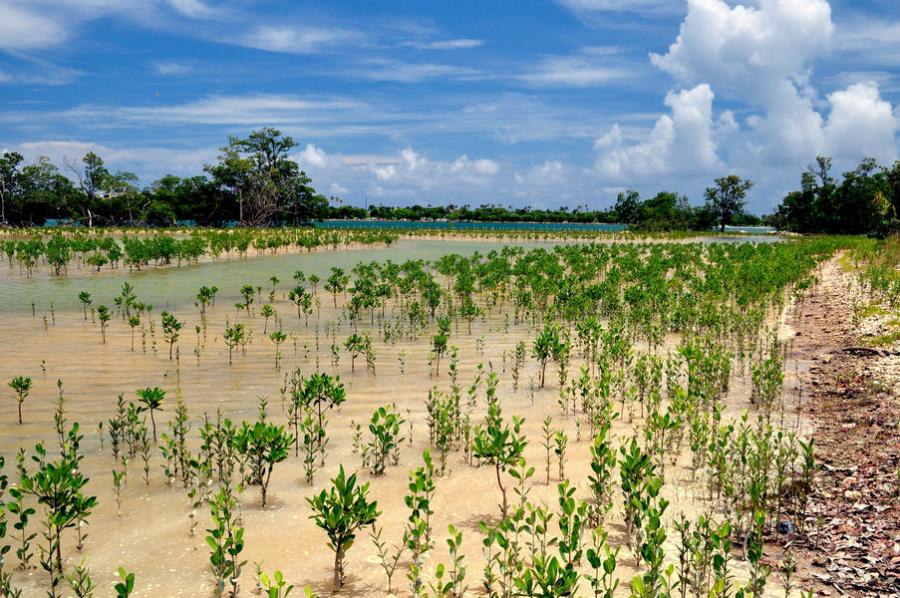
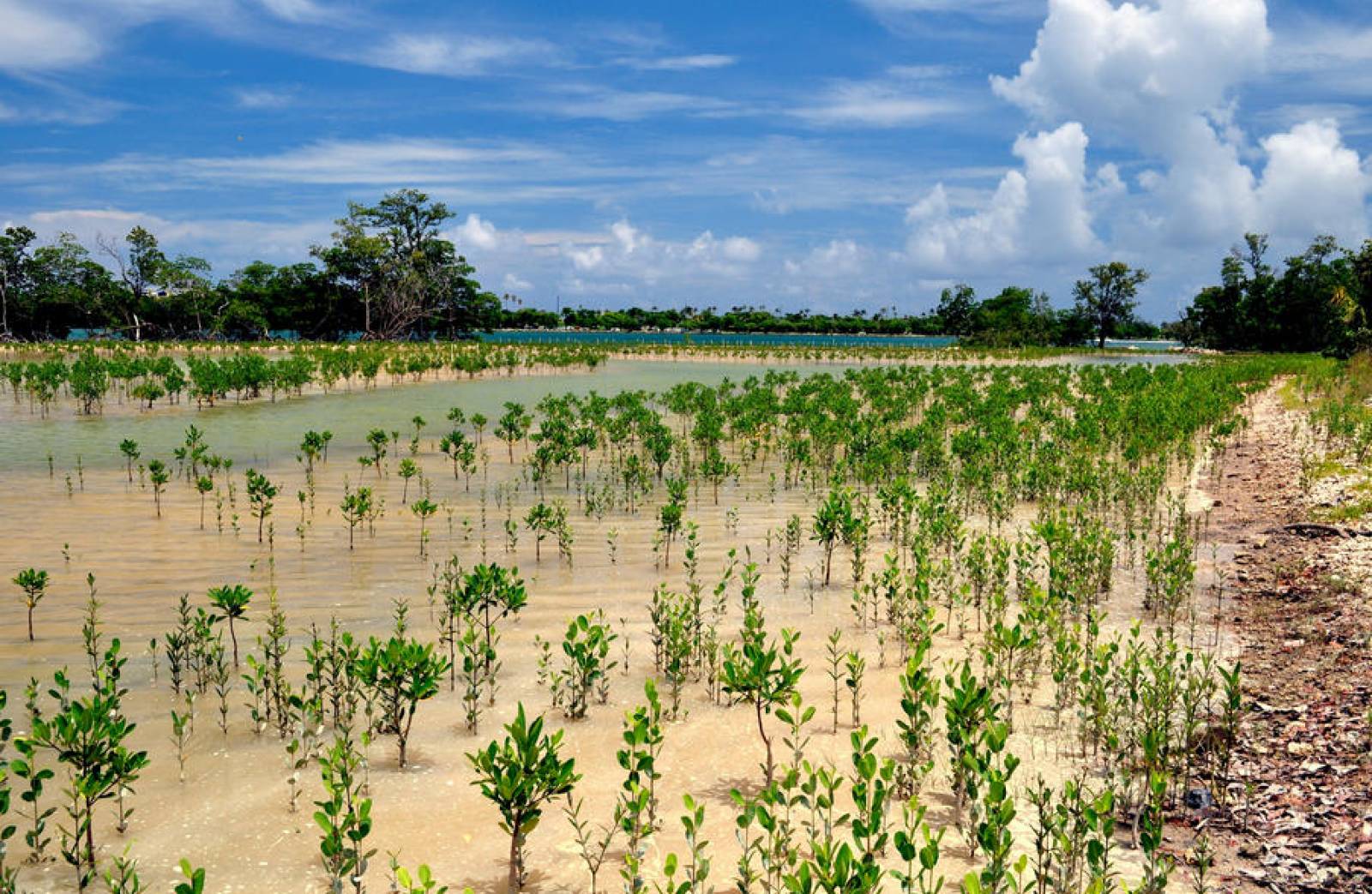
mangroves and
salt marshes. These plants provide habitat for numerous
shoreline organisms, protection from erosion or storm damage, and an important source of food in the bay.
Other intertidal communities include riprapped shorelines. Coastal upland plant communities consist of
hammocks, pinelands, and dune vegetation, and provide vital protection to the bay from the effects of upland
runoff and pollutant loading.
The rich fauna found in Biscayne Bay results from the diverse habitats found in the bay. In addition to fish
directly important to humans, such as snook, the mangrove and estuarine areas support a diverse collection of
other fishes that serve as links in food webs which benefit the entire Biscayne Bay ecosystem.
As summarized in SWIM TSD, seagrass habitat is especially prevalent in Biscayne Bay and the corresponding
fish fauna includes bonefish, ladyfish, pompano, permit, spotted sea trout, silver perch, hogfish, Nassau
grouper, red grouper, black grouper, gag, yellowfin mojarra, and crevalle jack (Alleman, et al., 1995).
Grassbeds also serve as a food source for the Florida manatee and as nursery grounds for several
important species of fish and invertebrates.
SWIM TSD scientists reported that at least 512 fish species occur in the bay as documented by de Sylva
(Alleman, et al., 1995). At least some of this diversity is due to the overlap of the Atlantic and the
Caribbean marine provinces. Fish species north of Cape Canaveral are typical of temperate waters, while
Florida Keys fish species are tropical. SWIM TSD scientists concluded that, "Biscayne Bay is part of a
transition area where fish species of both kinds are well represented. There is some seasonal fluctuation,
with tropical species more prevalent in the summer and temperate species partially replacing them in the
winter." (Alleman, et al., 1995).
SWIM TSD scientists reported that "An undetermined but very large number of invertebrate species live within
Biscayne Bay" (Alleman et al, 1995). Benthic surveys tallied over 800 species including over 150 species of
shrimp, crabs, and lobsters. Many of these species are commercially harvested including blue crab, stone
crab, spiny lobster, penaeid shrimp, and sponges.
Within hardbottom communities, the most common sponges are the loggerhead sponge (Spheciospongia vesparia)
and the basket sponge (Ircinia campana); Alleman, et al., 1995). Other commercial sponge species also occur
in the central and southern portions of the Bay. The importance of Biscayne Bay to juvenile spiny lobster
(Panulirus argus) has resulted in a large portion of the bay (roughly from Cape Florida south through Card
Sound) to be designated as the Biscayne Bay-Card Sound Spiny Lobster Sanctuary, as described in Chapter
68B-11, Florida Administrative Code.
Sea turtles that occur in Biscayne Bay may include the
Atlantic green turtle (Chelonia mydas), the
Atlantic hawksbill (Eretmochelus imbricata), the
leatherback (Dermochelys coriacea), the Atlantic
ridley (Lepidochelys kempi), and the loggerhead (Caretta
caretta; Alleman, et al., 1995). SWIM reports,
“Green turtles and loggerheads occur regularly in the
bay, whereas hawksbills seem to be less common, there,
at least in recent years (circa 1995). Hawksbill nests
have been recorded along the outer keys of Biscayne Bay
and leatherback nests have been recorded on Miami Beach
and Key Biscayne" as reported by Connally in the SWIM
TSD (Alleman, et al., 1995). "Green turtles and
loggerheads regularly forage within the bay. The
predominantly vegetarian green turtle feeds in grassbeds,
whereas the more omnivorous loggerhead finds a varied
diet of sponges, molluscs, crustaceans, sea urchins and
plants in hard bottom communities" (Alleman, et al.,
1995). Both the diamondback and the mangrove terrapin
are discussed from the 1950’s, but are not common today
(Alleman, et al., 1995). Other noteworthy reptiles that
are associated with the bay are the American alligator
(in freshwater tributaries) and the American crocodile,
a threatened species.
Many Biscayne bird "species are permanent residents of
the bay, other species migrate through the area, and still
others are winter or summer residents" (Alleman, et al.,
1995). SWIM scientists wrote that "Biscayne Bay is a major
stopover in the autumn migration of North American
shorebirds. Several species of shorebirds overwinter in
Biscayne Bay, making extensive use of shorelines and
intertidal areas" according to Wattendorf (Alleman, et al.,
1995). Major bird rookeries within the bay include the
islands of Bird Key in the northern bay and Chicken Key in
the central bay, Other rookeries are the mangrove shorelines
from Matheson Hammock extending south through Biscayne
National Park and along the western shores of Key Biscayne
and Virginia Key (Alleman, et al., 1995).
Rare / Endangered Species
Common Name |
Scientific Name |
State |
Federal |
| |
|
|
|
Fish |
|
|
|
| common snook |
Centropomus undecimalis |
n/a |
n/a |
| smalltooth sawfish |
Pista pectinatus |
|
|
| mangrove rivulus |
Rivulus marmoratus |
SSC |
n/a |
| |
|
|
|
Reptiles |
|
|
|
| American alligator |
Alligator mississippiensis |
SSC |
T (s/a) |
| Atlantic loggerhead turtle |
Caretta caretta caretta |
T |
T |
| Atlantic green turtle |
Chelonia mydas mydas |
E |
E |
| American crocodile |
Crocodylus acutus |
E |
E |
| Eastern indigo snake |
Drymarchon corais couperi |
T |
T |
| Atlantic hawksbill turtle |
Eretmochelys imbricata imbricata |
E |
E |
| gopher turtle |
Gopherus polyphemus |
SSC |
n/a |
| Kemp's ridley |
Lepidochelys kempi |
E |
E |
| Miami black-headed snake |
Tantilla oolitica |
T |
n/a |
| |
|
|
|
Birds |
|
|
|
| roseate spoonbill |
Ajaia ajaja |
SSC |
n/a |
| limpkin |
Aramus guarauna |
SSC |
n/a |
| piping plover |
Charadrius melodus |
T |
T |
| white-crowned pigeon |
Columba leucocephala |
T |
n/a |
| little blue heron |
Egretta caerulea |
SSC |
n/a |
| reddish egret |
Egretta rufescens |
SSC |
n/a |
| snowy egret |
Egretta thula |
SSC |
n/a |
| tricolored heron |
Egretta tricolor |
SSC |
n/a |
| Arctic peregrine falcon |
Falco peregrinus tundrius |
E |
E |
| American oystercatcher |
Haematopus palliatus |
SSC |
n/a |
| bald eagle |
Haliaeetus leucocephalus |
T |
T |
| wood stork |
Mycteria americana |
E |
E |
| osprey |
Pandion haliaetus |
SSC |
n/a |
| brown pelican |
Pelecanus occidentalis |
SSC |
n/a |
| least tern |
Sterna antillarum |
T |
n/a |
| |
|
|
|
Mammals |
|
|
|
| Florida panther |
Felis concolor coryi |
E |
E |
| West Indian manatee |
Trichechus manatus |
E |
E |
State listings are taken from the Florida Fish and Wildlife Conservation Commission or as
with plants Florida Department of Agriculture. Federal listings are taken from the
United States Fish and Wildlife Service. E= Endangered; T= Threatened; T (s/a)= Threatened
due to similarity in appearance; SSC= Species of Special Concern; UR= Under review; n/a=
information not available or no designation listed; C=Commercially exploited
Biscayne Bay lies in a depression between two limestone
ridges. The Atlantic Coastal Ridge forms the western
boundary and the Key Largo Ridge underlies the barrier
islands to the east (Alleman, et al., 1995).
Native peoples’ use of Biscayne Bay dates back as far as
10,000 years before present. Their use is documented in
archaeological sites such as the Cutler Fossil Site and
the Miami Circle. The Tequesta people lived along
Biscayne Bay during the time of European contact. Two
centuries after Europeans first visited, the last of the
Tequestas left Florida for Cuba. After this, two new
groups of Creek origin came to live in the Everglades
and along the coast. These groups, the Seminoles and
the Miccosukee both have reservations within the
interior of South Florida today.
For anyone who would like to explore Biscayne Bay, there
are a diversity of recreational and commercial in-water
activities, including power boating, sail boating,
catamaraning, canoeing, sculling, water skiing, jet skiing,
hang gliding, swimming, windsurfing, snorkeling, diving, and
fishing.
The Bay is also important navigationally as part of the
Intra-Coastal Waterway and home to a deepwater port, Miami
Harbor, one of the busiest cargo and passenger ports in the
world.
The Bay provides for a variety of educational and research
activities. Several marine science and education facilities
utilize the Bay and include: University of Miami Rosenstiel
School of Marine and Atmospheric Sciences (RSMAS), Florida
International University, Barry University, the National Oceanic
and Atmospheric Administration’s Atlantic Oceanographic and
Meteorological Laboratory and Southeast Fisheries Science
Center, and the Miami Seaquarium. On the secondary level,
Maritime and Science Technology (MAST) Academy is a local magnet
school located on Virginia Key and is dedicated to students
interested in marine science. In addition to these institutions,
several governmental agencies as well as scientists from remote
locations conduct research and education programs pertaining to
Biscayne Bay.
Biscayne Bay Aquatic Preserves consist primarily of
submerged lands and the water column over such lands as well
as publicly owned islands. Those submerged lands within the
boundaries of the preserve that are privately owned or
leased or which have been deeded to the County or
municipalities are also part of the Biscayne Bay Aquatic
Preserve. Both preserves have been designated as Outstanding
Florida Waters, Class III.
The preserves are managed by the Florida Department of
Environmental Protection, Office of Coastal and Aquatic Managed
Areas. Major management issues involve the protection of the
resources within the preserves in accordance with F.S. 258.397
and F.A.C. 18-18. In addition to monitoring and reviewing
projects which may impact the resources of the preserves,
efforts are also directed towards research and education.
Monitoring activities within the preserve include an extensive
water quality monitoring program and smaller benthic resources
program administered by SFWMD and Miami-Dade County Department
of Environmental Resource Management (DERM).
Alleman, R. W. 1995. An Update of the Surface Water Improvement and Management
Plan for Biscayne Bay. Planning Department, South
Florida Water Management District. West Palm Beach, Florida.
Alleman, R. W., S. A. Bellmund, D. W. Black, S. E.
Formati, C. A. Gove, and L. K. Gulick. 1995. An
Update of the Surface Water Improvement and Management
Plan for Biscayne Bay. Technical Supporting Documents
and Appendices. (Ed: Mulliken, J. D. and J. A.
VanArman). Planning Department. South Florida Water
Management District. West Palm Beach, Florida.
deSylva, D. P. 1984. A Bibliography and Index of the Biscayne Bay Ecosystem.
University of Miami School of Marine and Atmospheric Science, 91 pp.
Florida Department of Natural Resources. 1991. Management Plan (cabinet draft, not
adopted) For Biscayne Bay Aquatic Preserve Card Sound. Division of State Lands, 180 pp.
Metropolitan Dade County Board of County Commissioners. 1986. Environmental Resource
Management Department and Metropolitan Dade County Planning Department. 1986. Biscayne
Bay Aquatic Preserve Management Plan (draft, not adopted). Metropolitan Dade County,
Miami, Florida, 348 pp.
|